|
Home Updates Hydros Cars Engines Contacts Links Contact On The Wire |
Tethered
Hydroplanes
From 5 mph. to 135 mph. in
a Century
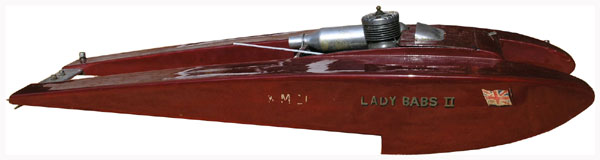
'Lady Babs'. Record holder 1949 to 1955
The first reference to a hydroplane is found in a patent awarded to the Reverend C.H. Ramus in 1873. He patented a model speedboat with a multi step hull, but the lack of a sufficiently high-powered engine prevented further development of the hydroplane at that time. The boat did achieve speeds of over 30 knots on a straight course, using rocket power.
At the beginning of the 20th century several clubs for model boat enthusiasts were formed in England, particularly in the Cheshire and London areas, and soon modellers were competing with one another to see who had the fastest boat.
From 1902 Model Engineer magazine instituted a 'Model Steamer Speed Competition' on a national basis. The first winner, was John Tharme from Birkenhead who achieved a speed of 5mph. His boat 'Express' was a steam driven displacement type launch and the speed was the average of 3 runs of 100 yards. The competition was soon renamed the 'Model Engineer Speedboat Competition' to take into account the growing popularity of Internal Combustion motors and this was run annually on a postal basis for the next 50 years.
|
|
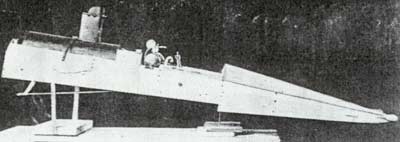
The next step came in 1908 with the appearance of ‘Folly’, built by Herbert Teague and Vernon Delves-Broughton. ‘Folly’ used a multi-stepped hull, powered with a flash steam plant and showed a level of performance hitherto unseen. The boat was run over 300 yards by means of a central tether mounted in a rowing boat, with each lap being 100 yards. |
This boat seems to be the first model designed purely as a racing boat and although controversial, and frowned upon by the purists, it did prove to be the answer if high speeds were to be obtained. This was the first occasion that a boat had been run tethered as most of the early competitions had been run on a straight course of 100 yards length, but as speeds rose so did the number of wrecked boats and such was the danger to the people stopping them that the central tether principle used so effectively with ‘Folly’ was adopted universally.
|
|
Speeds rose gradually for the next few years with 10mph being exceeded in 1911 by Herbert Teague with 'Incubus'. The fastest boats of the period were all powered by flash steam with the Noble Brothers, Herbert Groves and Fred Westmoreland all breaking the record by small amounts through to 1915. In 1918 the Americans claimed a record at over 30mph with a steam driven hydro, subsequently this was found to be a peak speed over just 50 yards. Steam was still out performing IC engines with Fred Westmorland achieving a speed of just 16mph with a four-stroke petrol engined boat, but 26mph with ‘Evil Spirit’, a steam powered boat that he had also built. |
Most of the early 'speed' exponents had retired from active competition by 1920, with the exception of George Noble who was still running hydroplanes through to 1957. In 1922 his 'Bulrush III' was the first hydroplane to break the 30mph mark.
|
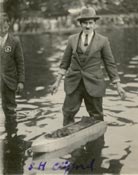
1924 saw the formation of The Model Power Boat Association (MPBA) and in the ‘Model Engineer Speedboat Competition’ that year; Stan Clifford achieved a speed of 36 mph with his flash steam ‘Chatterbox II’ boat. ‘Chatterbox III’ raised the speed in subsequent competitions to 43mph, which was to remain a record for ten years and was the last time the record was held by a flash steamer. |
|
The 1925 ‘Grand Regatta’ held at Victoria Park in London saw the first running of an event specifically for IC engined boats. It also saw the first visit to England of Mons Gems Suzor, a Parisian, who was to be a leading competitor and innovator for many years to come. He brought a boat called ‘Canard’ powered by a two-stroke engine of only 17cc, which would rev to 4000rpm. This boat and engine set Suzor on a competitive career that was unrivalled for many years. Between 1927 and 1939 he won 12 Regattas in France, 7 in England and 1 in Belgium. He resumed competition equally successfully following the end of the second war.
Up to this time almost all the engines in use were home built and there was no limits on engine size. The MPBA, in collaboration with the Model Yacht Club of Paris introduced a rule restricting engine size to 30cc, which still exists as the A class. Suzor built a new two stroke engined boat to this limit, with features that were to become normal practice, including the jointed prop shaft which is still used on every tethered hydroplane. This allowed the thrust line of the prop to be adjusted in order to control the attitude of the boat. In 1929, Suzor and his new boat ‘Nickie II’, set a record for IC engined boats at just under 32mph that was to last until 1933.
|
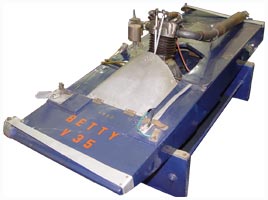
By the 1930s there were signs of commercial interest in the sport, with several manufacturers including Bonds, Grayson, Stuart and Economic Electric producing 30cc engines suitable for hydroplanes. In 1933 ‘Betty’, built by the Innocent Brothers of London, arrived on the competitive scene. The boat was powered by a 30cc four-stroke petrol engine and achieved a speed of 36mph in the ‘ME Speedboat Competition’ of that year. ‘Betty’ had a long and distinguished career recording 47.5 mph in 1936 and was still being used for demonstration runs into the 60s. 'Betty' has survived and is now in the care of the Victoria Club. |
|
In the early 30s it was felt that engines were becoming too powerful for the current hulls and a ‘miniature class’ was introduced. This was to be the B class with a capacity limit set at 15cc for IC engines or 12lbs weight limit for steam power. The A class still catered for the 30cc motors or steam plants up to 16lbs weight. One of the first successful competitors in the smaller class was none other than Captain Bowden who used an Atom Minor 2 stroke to power ‘Jildi Junior’. With this boat he reached a speed of 25 mph at the 1934 ME Competition. Two years later Mr L.J. French built a four-stroke boat called ‘Little Star’ which pushed the record to 34.68 mph. The late 30s also saw a further division of the classes with a C class for IC boats under 8½ lbs weight and steam boats under 7 lbs. Eventually a capacity limit was set at 10cc for C class IC motors.
|
|
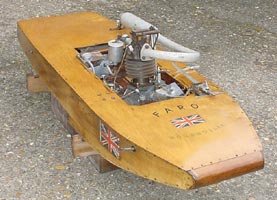
The 1937 season saw the arrival of one of the most consistently successful boats of the period. ‘Faro’, built by Ken Williams with his own 30cc four-stroke engine won the 1937 ME competition and by 1939 held the world record for A class boats at 47.5 mph. ‘Faro’ continued its winning career for many years and is still in existence being the last four stroke engine to hold the outright record. For a comparison, the record for B class at that time stood to J.P. Orme with ‘Skua’ at 40.78 mph. |
During the second war engine development and competition continued in the US and it was duly reported that boats were reaching speeds of 65-70 mph. This was viewed with some scepticism and suspicion in Britain, but when design details of the American boats were revealed it was obvious that several quite revolutionary ideas had been incorporated. The most significant of these was the surface-piercing prop.
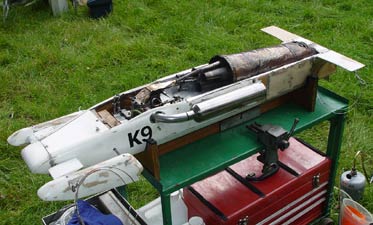
A hydroplane propeller, whether model or full sized will lift the back of the boat until almost half the prop is clear of the water. With careful hull and prop design this allows the rear of the hull to be clear of the water. In this configuration the prop is more efficient and there is less wetted hull area to cause drag. A further benefit is derived when the ‘step’ of the boat is divided to give two small running surfaces or sponsons with a tunnel between them. With this set-up the boat can be balanced so that only the prop and the tips of the sponsons are touching the water and if the aerodynamics are correct, just the prop.
However, to achieve this degree of balance, there are two other vital ingredients. The first was the two point bridle to attach the boat to the tethering line and the second was high performance and high revving commercial two stroke engines, mostly McCoys, Hornets and the occasional Dooling. These engines had abandoned the conventional coil or magneto ignition and were all using the simpler glow plug ignition. Builders in England were soon utilising these same principles to great effect, with George Stone of the Kingsmere club breaking the British record by 20mph in 1949, later raising it to 75.6mph with his Dooling engined boat ‘Lady Babs II’. (See heading photo)
|
|
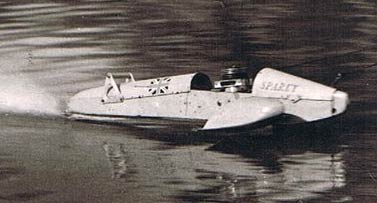
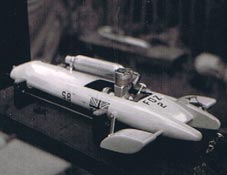
These same ingredients both appeared in George Lines’ famous boat ‘Sparky II’ which had a 15cc engine that was the first pure racing glow plug motor used in this country. As manufacturing and competition returned to Europe after the second war new and smaller engines appeared and their development led to further classes being established to meet the common capacity limits. There were now classes for 2.5cc, 5cc, and 10cc engines, with the UK and US also running 15cc and 30cc classes. |
|
In the first 50 years of the sport, the tethered hydroplane evolved into what we recognise today. The second 50 years have seen significant refinement but with no major change to either the hull form or propulsion system. The hulls became, longer, slimmer and more streamlined with airfoils at the stern to aid stability from the late 1970s. Engine development has dictated the use of tuned pipes in all classes and coupled with ever larger propellors has necessitated the use of a bungee to aid launches, although this was first tried in the 1950s. |
|
|
|
Foz II 76.6mph in 1955 |
Slipper V 78.76mph |
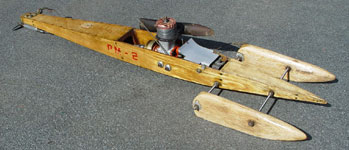
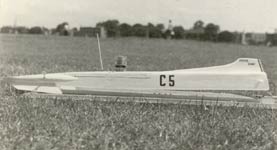
Through the following decades, George Stone, Ken Hyder, Terry Everitt, Arthur Wall, Stuart Robinson, John Rose, Roger James, John DeMott, and others, continued to develop their boats to keep pace with speeds being recorded elsewhere in the world. In 1958 the World record stood to Jean Menant of France at 95 mph with his McCoy engined boat. 1961 saw the first ever 100mph run, achieved by W. Kalfus with a 30cc boat, in America, but by this time the sport was in decline in the States, and from the mid sixties onward all further development was concentrated in Europe, East and West.
 |
 |
 |
| 1960's copy of Menant's Spido record boat | 1972 Petite Chat first British 100mph run | 1981 120mph OPS engine |
|
|
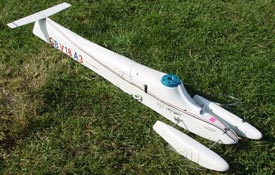
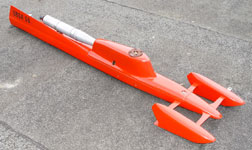
The first 100mph run in England fell to Arthur Wall in 1972 with a Rossi 60 powered boat. It took just three years for Ian Berne to reach 110mph and a further six for Stuart Robinson to exceed 120mph. By 1985 Terry Everitt had recorded 130.05mph with an OPS 60, which was the world's fastest at that time. The 135 mph referred to in the title stood to Norman Lara from 1998 to 2014 when he was the first to break the 140mph barrier to set the current outright record at 141.7mph. Left: 1990s to present. Picco or OPS motors, silenced tuned pipes, fully cowled with rear aerofoils |
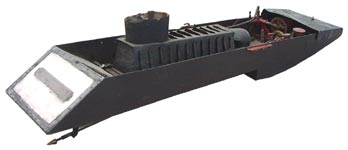
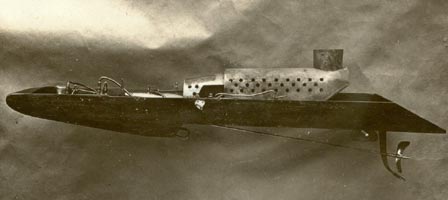
In the early years of tethered hydroplanes, steam and flash steam was the normal source of power, easily outperforming IC engines. As more powerful and smaller petrol engines were developed, the emphasis moved away from steam and it would be easy to presume that as a power source it had died out. Nothing could be further from the truth. The IC engine was easier to install and operate and at times made leaps in power that the more established ‘steamers’ could not emulate, but committed groups of enthusiasts continued to persevere with flash steam and have managed to match the performance of the IC boats in the larger classes. From the earliest days of H.H. Groves through the work of Stan Clifford, John Benson, Alan Rayman, Bernard Piliner and Arthur Cockman, with his ‘Iffit’ series of boats, to the modern exploits of Stan Poyser, Ian Berne and Bob Kirtley the flash steam hydros have held their own in the UK.
 |
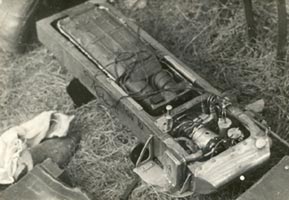 |
| Irene II 21.19mph prior to WW1 | Vesta II 51mph in 1949 |
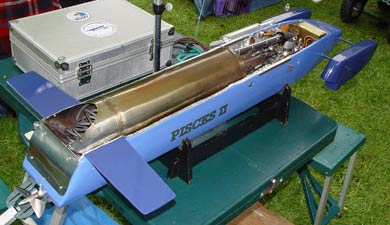
It is important to remember when considering the relative performance of flash steam powered hydro’s is the fact that any development is down to the builder. The ideas, the manufacturing, the testing, the development, the errors and frustration are down to the individual; there is nothing available commercially. Through enthusiastic and dogged experimentation and development Bob Kirtley improved the performance of his ‘Pisces I’ boat from an initial 46 mph to a British Record in 1980 of 72 mph. Ian Berne took on the challenge of running a steamer and by 1988 had put in a record speed of 88 mph. Bob Kirtley returned with a new boat ‘Pisces II’ to make the first ever run at over 100 mph with a flash steam hydroplane in July 89. By October that year he had reached 107 mph and the speed has continued to rise year on year, passing the landmarks of 110 and then 120mph. On numerous occasions his boats have held outright British class records. From the mid 1990s Bob has been challenged by Paul Windross a multiple national record holder on motor cycles. Paul eventually broke the flash steam record in 2012 and then raised it to within a whisker of 130mph the following year.
 |
 |
| 1989 First 100mph run | 129.33mph at Kingsbury Lake 2013 |
British Outright Speed Records for Tethered Hydroplanes
|
Date |
Owner |
Boat |
Class |
Engine |
Speed |
|
1902 |
JOHN THARME |
EXPRESS |
A |
Single cylinder steamer |
5 mph |
|
1903 |
W.R. WEAVER |
ERA |
A |
2 cylinder compound steamer |
7 mph |
|
1904 |
D. SCOTT |
BON ACCORD |
A |
Steam |
7.72 mph |
|
1906 |
W.R. WEAVER |
ERA |
A |
2 cylinder compound steamer |
8.77 mph |
|
1907 |
W.H & F.G ARKELL |
MORAIMA |
B |
50cc single cylinder petrol |
9.71 mph |
|
1908 |
H. TEAGUE & V.W DELVES-BROUGHTON |
FOLLY |
C |
Twin cylinder flash steam |
13.12 mph |
|
1908 |
HERBERT TEAGUE |
INCUBUS |
B |
Twin cylinder flash steam |
15.05 mph |
|
1909 |
HERBERT TEAGUE |
INCUBUS |
B |
19.76 mph |
|
|
1911 |
HERBERT TEAGUE |
INCUBUS |
B |
21.71 mph |
|
|
1913 |
G.D & S.S NOBLE |
BULLRUSH |
C |
Twin cylinder flash steam |
22.77 mph |
|
1914 |
H.H. GROVES |
IRENE IV |
D |
Twin cylinder flash steam |
24.25 mph |
|
1915 |
F. WESTMORELAND |
EVIL SPIRIT |
D |
Twin cylinder flash steam |
25.06 mph |
|
1922 |
G.D. NOBLE |
BULLRUSH III |
C |
Twin cylinder flash steam |
32.56 mph |
|
1924 |
S.H. CLIFFORD |
CHATTERBOX II |
B |
Twin cylinder flash steam |
36.30 mph |
|
1925 |
S.H. CLIFFORD |
CHATTERBOX III |
B |
Twin Cylinder flash steam |
37.00 mph |
|
1926 |
S.H. CLIFFORD |
CHATTERBOX III |
B |
41.85 mph |
|
|
1926 |
S.H. CLIFFORD |
CHATTERBOX III |
B |
43.30 mph |
|
|
1936 |
S.L. & J.B. INNOCENT |
BETTY |
A |
Single cylinder four stroke |
47.47 mph |
|
1940 |
K.G.WILLIAMS |
FARO |
A |
Single cylinder four stroke |
47.50 mph |
|
1948 |
K.G.WILLIAMS |
FARO |
A |
51.17 mph |
|
|
1949 |
G.STONE |
LADY BABS II |
C |
Dooling 60 (10cc) |
70.10 mph |
|
1951 |
G.STONE |
LADY BABS II |
C |
75.60 mph |
|
|
1955 |
R.A. PHILLIPS |
FOZ 2 |
C |
Homebuilt 10cc |
76.60 mph |
|
1957 |
K. HYDER |
SLIPPER 5 |
C Res |
McCoy 60 |
78.76 mph |
|
1963 |
T. EVERITT |
C Res |
McCoy 60 |
81.10 mph |
|
|
1968 |
D. SCARNELL |
C Res |
Rossi 60 |
83.96 mph |
|
|
1969 |
S. ROBINSON |
C Res |
Supertigre 60 |
87.40 mph |
|
|
1970 |
T. EVERITT |
C |
Homebuilt 10cc |
88.94 mph |
|
|
1970 |
S. ROBINSON |
C Res |
Rossi 60 |
95.12 mph |
|
|
1972 |
A. WALL |
C Res |
Rossi 60 |
96.47 mph |
|
|
1972 |
A. WALL |
C Res |
Rossi 60 |
98.83 mph |
|
|
1972 |
A. WALL |
C Res |
Rossi 60 |
100.52 mph |
|
|
1973 |
S. ROBINSON |
C Res |
Rossi 60 |
103.28 mph |
|
|
1975 |
I. BERNE |
C Res |
OPS 60 |
110.74 mph |
|
|
1977 |
J. HYDER |
C Res |
OPS 60 |
111.16 mph |
|
|
1981 |
S. ROBINSON |
A3 |
OPS 60 |
124.28 mph |
|
|
1985 |
T. EVERITT |
A3 |
OPS 60 |
131.50 mph |
|
|
1997 |
N. LARA |
A3 |
OPS 60 |
134.27 mph |
|
|
1998 |
R. JAMES |
A3 |
OPS 60 |
134.90 mph |
|
|
1998 |
N.LARA |
A3 |
OPS 60 |
135.57 mph |
|
| 2014 | N LARA | A3 | PICCO 60 | 141.7mph |
Thanks to Peter Hill for the information included in this article.
©copyrightOTW2016