|
Home Updates Hydros Cars Engines Contacts Links Contact On The Wire Next→ |
Celebrating 100 years of tethered hydroplane racing
Beyond the ‘Follys’, H H Groves
With Teague and Delves-Broughton ‘retiring’ at the end of 1911, the development of tethered hydroplanes passed to the next generation of competitors. George and Samuel Noble from Bristol, were the first to take on the mantle of record breakers. The Noble brothers started running boats in 1911 and achieved a unique mark by having no less than 4 boats win awards in the 1913 Model Engineer Speedboat Competition, with Bulrush taking the outright record from Herbert Teague and ‘Incubus’ at 22.77 mph. Along with the Noble Brothers, Fred Westmoreland from Salford was also beginning his involvement with racing boats that was to culminate in a World record in 1915. OTW has already published a very detailed account of Fred and his modelling career and now turns its attention to his friend, mentor and fellow flash steam pioneer, H.H. Groves.
|
|
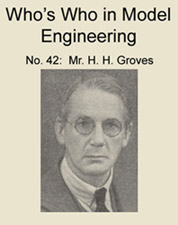
H.H. Groves is described in one publication as ‘a man of mystery’, and it goes on to say that ‘it is not even known what the H.H. stands for’. Herbert Harry Groves was born in Longacre London on the 27th April 1882. His father, Harry Clark Groves was born in 1858 in transit on a Swedish ship, so his place of birth is registered as Stockholm. Following his education, Harry became an electrical instrument maker, working for Evershed and Vignole at Acton. In December1880 he married a Chelsea girl, Frances Sarah Brush and moved to 6 Mercer Street, St Martin In the Fields where H H was born, 16 months later. |
|
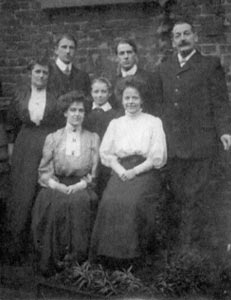
A sister Minnie, followed in 1884 and a brother, Lewis in 1886 after which the family moved to 35 Gertrude Street Chelsea. Another brother Archie arrived in 1899. Even after his education at Clock House School Chelsea, and a course in electricity at South Western Polytechnic, Herbert had little idea what he wanted to do, initially working in a publishing office. He then moved to engineering and instrument making with Elliot Bros of St Martins Lane, where he spent the next three years. Another move took him to Nalder Bros & Thompson for a short while doing experimental and development work on electrical instruments. It was while he was at Nalders that he was to meet his future wife who was also employed there. Groves was obviously finding it difficult to find a position that suited him as he moved on again to the ‘Solenoid Engineering Company’ as manager of the engineering department, where he stayed for 2 ½ years. Groves family photo
taken in 1911. Back row: Lewis, Herbert and father Harry. |
|
|
|
Although he is best known for his pioneering work on flash steam plants for model aeroplanes, he developed a lifelong interest in ‘model aeronautics’, model engineering and steam power. Looking back, the use of steam plants in model aircraft may sound a trifle strange, but 100 years ago, the internal combustion engine was in its infancy and steam had been used as a power source in both full sized and model aeroplanes for a considerable while (with little success it has to be said). By 1908, when the exploits of Herbert Teague and Vernon Delves-Broughton and their flash steam hydroplanes were publicised, Groves was already well advanced on his own ultra lightweight flash steam plant. On January 1st 1909 the Kite and Model Aeroplane Association, which later became the SMAE, was formed with Herbert Groves as one of its founder members. |
|
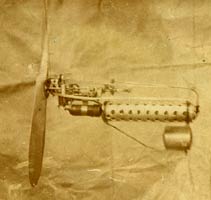
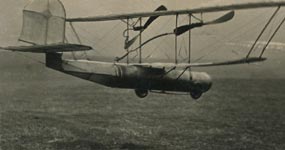
In September 1909 he married Florence Mary Stevens, moving to 18, Westerdale Road in Greenwich. Following the move south of the river, Groves was soon back at work on the steam plant for his model aeroplane, which he completed in September 1911. The aeroplane flew successfully on just its second outing. In 1912, Model Engineer reported that he had perfected the plant and had achieved flights with the canard pusher monoplane of ‘approximately 30secs, attaining 100ft altitude using 2ozs of water evaporated by 3/4oz of benzoline’. The steam plant with its horizontally opposed twin cylinder motor weighed just 1½ lbs. |
|
|
|
It would seem that at the same
time he was undertaking this ground breaking achievement with the
aeroplane, he was spurred on to create a similar plant suitable for a
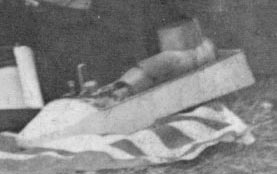
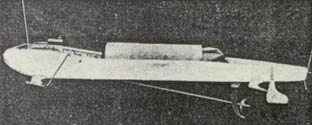
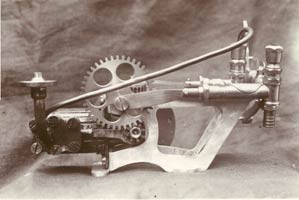
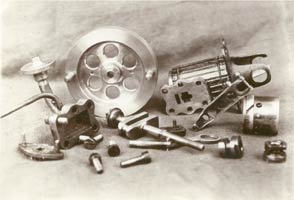
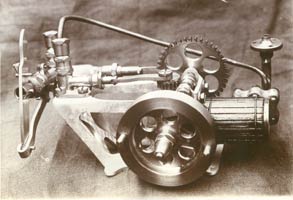
tethered hydroplane. The ‘Groves Miniature Hydroplane’ was
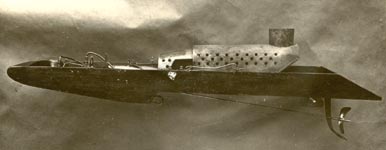
constructed during 1911for the proposed 24" class and again described in
Model Engineer during 1912. |
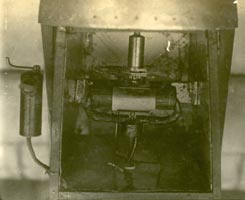
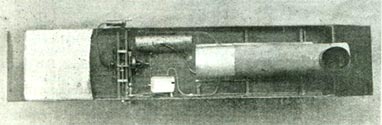
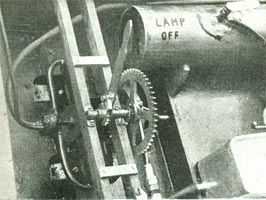
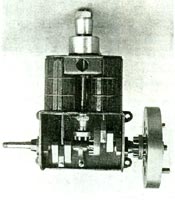
This time, the motor was a single cylinder version of the aero engine built in unit with water and oil pumps and associated valves on an aluminium frame that was bolted directly into the hull of the boat. The blowlamp, fuel tank and steam generator with its iron lagging were much bigger and heavier as weight was not such a vital consideration.
 |
 |
 |
Record Breaker
|
In Dec 1911, a daughter was born to Herbert and Florence whom they christened Irene, and from then on, Groves’ boats would carry her name. ‘Irene 1’ was the first metre boat that Groves built and for some reason he ignored the design trends that were evolving to produce a narrow, stepless hull with two small outriggers near the bow. |
|
The power unit for the first 'Irene' was the horizontally opposed twin that had seen service in another of his aeroplanes, a biplane pusher canard. With its very steeply raked shaft and minimal planning surfaces the boat, was extremely fast, but completely unstable and persisted in ‘diving in’ or capsizing on almost every run. 'Irene I' was therefore abandoned, and the hull given to 18 month old Irene and a playmate.
|
|
In order to overcome these tendencies, ‘Irene II’ was a new design, working on lines similar to Teague and Delves-Broughton’s ‘Folly III’. The single step hull was rectangular in plan; one metre long and around eight inches beam with steeply inclined front and rear planes. |
|
Initially 'Irene II' was fitted with the engine from the first 'Irene', but this was intended to rev at around 2500rpm and Groves wanted nearer 4000 for high speed. The twin vibrated excessively at the higher speeds and so a new engine was designed specifically for use in the boat. |
|
|
|
The new twin cylinder motor was fabricated from steel sheet and tube, brazed together. A simple peg gear drove a rotary valve between the cylinders acting for both admission and exhaust, although there were a set of drilled ports in the cylinder wall, effectively creating a uniflow configuration. The motor along with the pumps on a separate frame was laid horizontally in the front half of the boat, with the steam generator occupying the rear half. A single burner blowlamp was mounted in the middle of the boat with the fuel tank alongside mounted fore and aft.
|
|
The design, layout and construction of the boat and steam plant were so successful that ‘Irene II’ produced a record-breaking run of 21.9 mph in 1913 that also won a silver medal in the ME Speedboat Competition. |
|
|
|
This was to be the boats swansong as it was so severely damaged when the steel line broke, that Groves scrapped the hull and transferred all the equipment to a new and identical hull that became ‘Irene III’. This boat also had a very short lifespan as it in turn was destroyed when the pole it was tethered to toppled over. Another new hull, with slight modifications was quickly built and the steam plant that had now survived two accidents went into ‘Irene IV’.
|
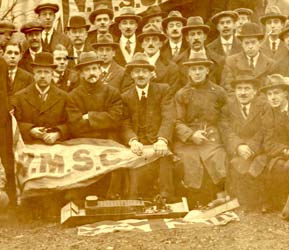
The new boat again proved that the design and engineering was spot on, setting a new record of 24.25 mph in 1914, but this would seem to be the end of Groves’ competitive involvement with tethered hydroplanes for a while. Herbert Groves and Fred Westmoreland had become very good friends by this time, probably through meeting at the Victoria Club where Groves was a committee member, and Fred freely admitted that he based his record breaking ‘Evil Spirit’ almost precisely along the lines of ‘Irene II and III’. Indeed, in September 1915 when he had finished building his own powerplant, he visited Groves, and they put it into Irene’s hull for a test run. Right: Victoria Model
Steamboat Club circa 1920. Fred Westmoreland is seated 3rd from left |
|
|
|
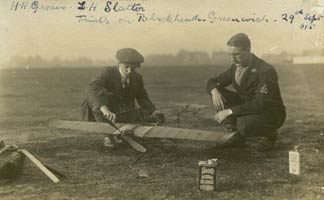
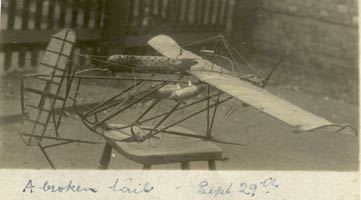
On 29th September they had taken Groves’ flash steam monoplane to Blackheath where they met up with Leonard Slatter, another model aircraft pioneer. Slatter was the last winner of the original ‘Wakefield’ contest and gold trophy and later became a highly decorated RAF Air Marshall. |
|
After several attempts to emulate ‘Fokker speeds’ they eventually managed to wreck the 5ft 8inch span canard when it hit a bank and broke the ‘chassis’. Following the test runs, Fred returned to Salford to complete ‘Evil Spirit’, and after many trials and tribulations broke Groves’ world record with a run of 25.06 mph on Boxing day 1915. |
|
Both Fred and Leonard Slatter joined the Royal Naval Air Service serving to the end of hostilities, while Groves moved in 1917 to the nearby Woolwich Arsenal, working for the rest of the war as a tool and gauge maker. In April 1918 Irene gained a brother when a son, Herbert was born by which time Herbert senior was concentrating his skills on model aircraft again.
|
|
Indeed, it was to be one of his flash steam planes that brought about a change of career and eventually, a move from Greenwich. Around 1918 he had entered his aeroplane into a competition and was pitted against a compressed air driven machine, built by Charles Desoutter.(seen left) The quality of the engineering, allied to the superb performance of Groves’ plane and steam plant so impressed Desoutter that he offered Groves a job with his company, Desoutter Brothers, probably better known for making artificial limbs and air driven tooling than the aircraft that carried the company name. |
|
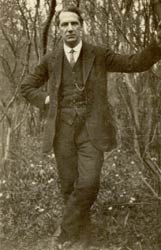
There was yet another addition to the Groves family in July 1920 when a second son, Kenneth, was born. Earlier that year, the Model Engineer had lamented on the lack of entries in the annual Speedboat competition and urged their readers to consider participating. This fired Groves’ imagination, but although he still had the steam plant from ‘Irene IV’, the hull was long gone. He came up with a new boat, based on the construction and design of the original ‘Miniature Hydroplane’ using sheet Dural riveted together to form the metre long hull. The same twin cylinder motor that had done such sterling service was fitted, along with a more efficient twin coil steam generator and twin burner blowlamp. He named this new boat ‘Berti’ after his son Herbert. The boat was displayed on the South London Club stand at the 1922 ME exhibition and in the Speedboat Competition that year, ‘Berti’ recorded 21.6 mph in class D. Right: HHG photographed on Wimbledon Common in the early 1920's |
|
CopyrightOTW2008