|
Home Updates Hydros Cars Engines Contacts Links Contact On The Wire ←Previous |
Celebrating 100 years of tethered hydroplane racing
H. H. Groves, engineer
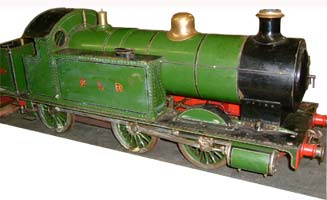
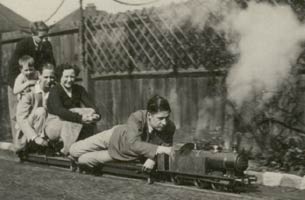
When Desoutters transferred their premises from Baker Street to the Edgware Road at Hendon in 1924, Herbert, Florence and the children moved to a new home in Queens Walk, Kingsbury, where another son John was born in 1929. By the end of the decade, flash steam was being overtaken by IC engines, especially in planes, and for the time being Groves turned his attention to building steam locomotives. The first engine he completed was a 2 ½" gauge LBSC designed ‘Fayette’ to be followed by the 5" gauge ‘Pioneer’. Construction on the engine designed by N.D Willoughby began in 1933 with Groves spending an average of 20 hours a week in the workshop. The completed chassis was exhibited at the 1934 ME exhibition and by 1936 Exhibition was running on the SMEE track where it won a special trophy, donated by Jim Crebbin. Groves also built a ground level track in the garden of 32, Queens Walk, where the family would enjoy rides behind the loco sitting on a truck, while the driver assumed a most uncomfortable position on a flat driving trolley. The locomotive was described in detail by Groves in a series of articles in ME during 1936.
 |
 |
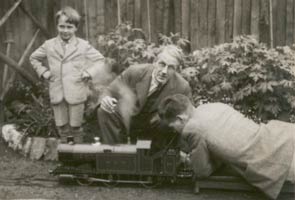 |
| Left: Pioneer around 1936. Centre: 1935 Irene, Bert, John & Ken at rear. Driver Cedric Harpley. Right: John, HHG & Bert. | ||
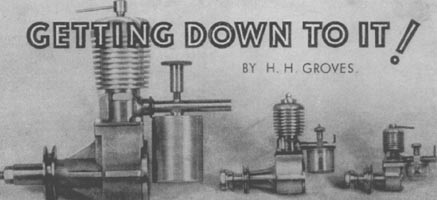
Having finished ‘Pioneer’, Groves was persuaded by some his friends to contribute again to the design of flash steam model aircraft. Around 1935, he produced two complete steam plants, mounted on frames that enabled them to be attached directly to the fuselage of a model. One of the plants he kept and the other was ‘fitted to a model aeroplane of design and construction quite comparable to the engine’ by R.J. Trevithick. The smaller of the two plants, weighing just 8oz, was described in ME in April 1936. From 1912 onwards Groves contributed some 50 or more articles and letters to the ME and other magazines describing his projects, offering advice on constructional techniques and discussing various aspects of ‘design philosophy. Many of these articles were incredibly detailed and illustrated with numerous photographs and very precise engineering drawings.
In the early years of the second war, ‘Pioneer’, along with its trucks and track was sold to George Lutz who had moved to nearby Greenhill, when the family bakery in Holborn was destroyed during the Blitz. This is where family connections are somewhat uncanny, as George Lutz, who used to race full sized hydroplanes on the nearby Welsh Harp, had married Fred Westmoreland’s daughter Edna and also became Vice Chairman of the MPBA. It seems likely that Groves, Lutz and Westmoreland had become acquainted through their mutual involvement with tethered hydroplanes and the Victoria Club.
Having risen to the position of general manager, Herbert Groves decided in 1937 that working for Desoutters was becoming too stressful, as he was essentially an engineer rather than a manager, so decided to retire at the age of 55. On of his first tasks after retiring was a ‘super spring clean’ of his workshop where he unearthed the remains of two flash steam hydroplanes that he decided to dispose of. As he did not want to sell the boats, Edgar Westbury was entrusted with the task of finding good homes for them, and after describing each in some detail in Model Engineer in July 1938, asked for interested parties to contact him and then he would make the decision as to where they went.
|
|
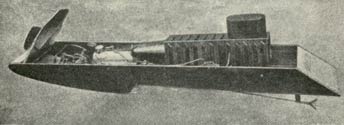
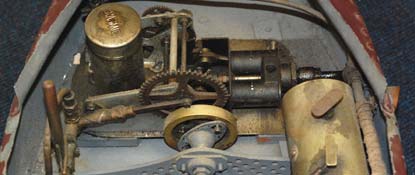
The first was the original 'miniature hydroplane' and the second a metre boat described as ‘Irene IV’. This had a Duralumin hull, similar in style to the earlier 24" boat, which meant it could not be one of the ‘Irene’ series as the illustration of Irene IV, left, confirms. The motor was the same twin as used in all the previous boats, but the steam generator was twin coiled with a twin burner blowlamp. |
Recent research has determined that ETW made an error in identification and that it was actually the last boat Groves built, ‘Berti’. Eventually Westbury announced that the ‘Miniature hydroplane’ had been given to a Mr A Jones in Speke, Liverpool, while the metre boat had gone to a Mr Bullivant in Minehead Somerset.
Groves was far from idle in his retirement, constantly coming up with ideas and gadgets, including the diaphragm aquarium pump that is so familiar to this day. As well as building at least three 35mm cameras, he also came up with a novel photographic developing tank that would separate roll film from the paper backing and then develop it in broad daylight. He offered the idea to Kodak who wanted to buy it outright, but he was so convinced of its future that he preferred royalties on each tank produced, which they refused. Of course, as so often happens, the daylight-loading tank became a common item and although Herbert held the patent for it, did not receive a single penny for his idea.
|
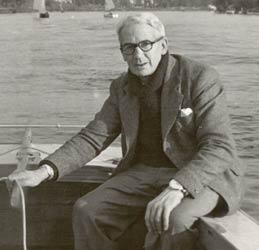
His ingenuity and skill was utilised in a most unusual fashion during the Second war. Son Kenneth worked at the GPO research establishment at Dollis Hill and was involved in the construction of ‘spy radios’ and in particular grinding the frequency control crystals. He was faced with difficulty in mounting these crystals and presented father with the problem. Herbert came up with a simple solution for a frame that was met with disbelief that it had come from a ‘garden shed’ workshop, but nevertheless was adopted and used throughout the war. He was given the contract to make the frames and ended up working from 9 in the morning until 9 at night, 5 or 6 days a week to satisfy demand. Apart from all his modelling interests, Groves was also a very keen sailor, enjoying this more leisurely pursuit on the Thames above Teddington Lock and on the lake at Aldenham near Elstree, so he stipulated that he wanted one day off per week to go sailing, which he did. |
|
|
|
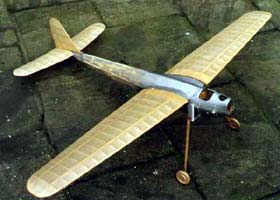
Model aircraft were never far from Groves’ mind having built rubber-powered Wakefield models and a plane along the same lines intended for a more modern flash steam plant. With the arrival of the small diesel engine after the second war, Groves came up with a novel way of combining the power of the IC motor with the characteristics of a rubber-powered model. |
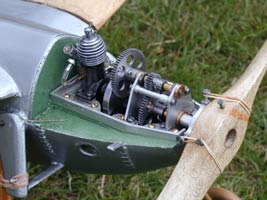
Lawrence Sparey produced a design for a 5cc diesel suitable for home construction, which Groves scaled down, firstly to 1/3rd size and then to ½ size, describing his experiments in Model Mechanic in 1947. The 1/3rd size motor of 0.189cc capacity was installed in a 25" span model of a Leopard Moth that weighed just 4oz.
|
|
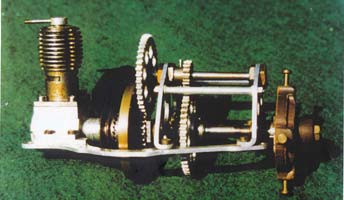
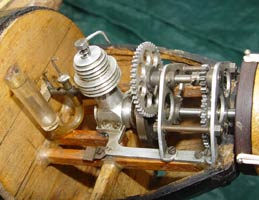
The idea behind these diminutive motors was to mount them in unit with a compound reduction gearbox on a frame in order to drive a very large propeller slowly to improve efficiency. It would seem that three of these units were built for different sized motors for Wakefield style airframes, the last in the early 50s. Left: Original Groves engine and gear drive unit. Photo courtesy of Ken Croft. |
|
Towards the end of the decade, Groves, along with his son Herbert (Bert), moved into ultra miniature railway modelling, building electrically powered locomotives and complete layouts to a scale of just 2mm to 1ft. This is reckoned to be the smallest scale that it is possible to work in and retain realistic and functional models. By 1960 they had perfected the technology to the extent that their layout ran faultlessly throughout the Model Railway Exhibitions of 1961/2/3/5. So successful were they in this venture that they created the wheel standards and profiles that are still in use to the present day and Bert was honoured by being elected as President of the 2mm Association. Right:- HHG with son Bert, diminutive 4-6-2 locomotive and part of 'Rydes Vale'. |
|
During the early 60s, Groves’ health was beginning to deteriorate and he was beginning to find it a struggle to maintain the level of engineering and activities that he had been used to. Early in 1965 he contracted pneumonia and on 25th January 1965, Herbert Harry Groves died of heart failure. The ‘Rydes Vale’ layout was exhibited at the Model Railway Exhibition of that year by Bert as a tribute to his father and his engineering skills and innovation.
H. H. Groves, the legacy
Having started serious research into the life of H.H. Groves we followed up every piece of information and lead that related to him or any items of his that might have survived. From the GRO we established that Irene had died in 1990 and Kenneth in 1996 and we knew that Herbert junior had made himself known to avid aviation historian Mike Beach, during an exhibition at the Brooklands Museum in Weybridge. We tried to contact him via the 2mm Association, only to discover that he too had sadly passed away in March 2008. This left us with the basis of a story from what could be gleaned from various magazines, but then occurred the most amazing stroke of luck imaginable. Groves’ youngest son John, of whom we were totally unaware, made contact with the MPBA historian Peter Hill and set in motion, not only this article, but complete updates of the story of Fred Westmoreland and ‘Evil Spirit’. In the 6 months since the original contact it has been possible to establish that many of the items built by Herbert Groves are still in existence, which all added to the general excitement.
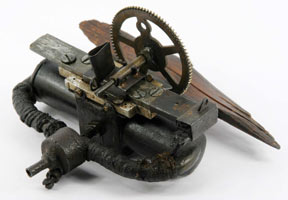
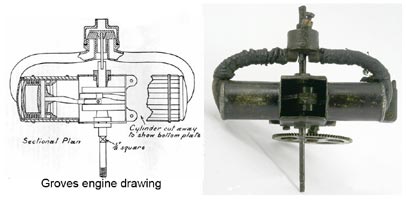
The first artefact to be identified was the original twin cylinder flash steam from Groves’ 1912 monoplane already referred to. This turned up at a swap meet some years ago and its discovery was reported in an issue of Model Engine World. Amongst the archives were several photos of the plane and of the actual motor installation.
|
|
|
| Photo's of the engine and comparison with Groves' original drawing by courtesy of Ken Croft. | |
The story of the 24" miniature hydroplane developed into a 96 year ‘saga’. Built in 1911/12 and then passed to Mr Jones in 1938 it was reported in the October 1951 issue of Model Ships and Powerboats, that it had been rediscovered in a Liverpool junkshop around 1947. In the early 60s, a copy of this magazine was given to Peter Hill who wondered what had become of the boat since then?
|
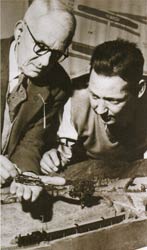
About 1990 Howard Jackson turned up at one of the Birkenhead hydroplane regattas with a very early flash steam hydroplane that had belonged to a friend of his and lain in his workshop for many years. Jimmy Jones thought that it might be significant and referred Mr Jackson to Peter Hill who instantly identify it as the Groves Miniature boat, that he had seen all those years ago in the magazine. Peter arranged to collect it from Birkenhead and it was eventually placed in the Pitsea Museum and described in Model Boats for April 1993. Following the redevelopment at the museum, the boat was retrieved so that John Groves could see it for the first time in 70 years. The Westmoreland archives also produced the only contemporary photo of Herbert Groves with the boat, as well as a series of views of the engine. The engine has been refurbished and runs at some 6000 rpm on 25 psi air pressure, but the steam generator and blowlamp are in too dangerous condition to risk using. |
|
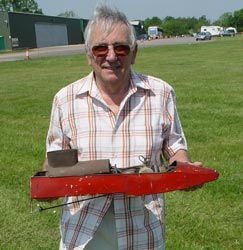
Model Boats for May 96 included two photographs of a boat labelled ‘Irene III’ record-breaking hydroplane by H.H. Groves. In fact it was the second of the metal hulled boats passed on by Westbury in 1938, referred to as ‘Irene IV’, but actually the 1920 ‘Berti’. It had been passed to the Society of Model and Experimental Engineers at some stage, and remains in their safekeeping.
 |
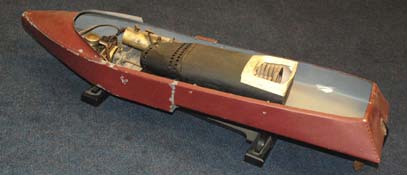 |
| Motor that powered Irene II, III and IV . 24.25mph Irene IV. | Now identified as 'Berti' last run in 1922. |
|
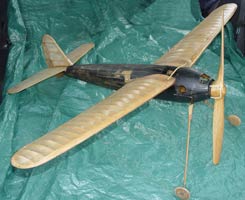
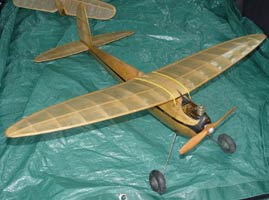
Of the later aeroplanes that Groves built, the family have retained one of the original versions with the engine gearbox unit, along with another IC powered model, both still in the fitted wooden carrying case. |
||
 |
 |
 |
|
This is not quite the end of the story of Groves' aeroplanes as there has been a great deal of discussion and conjecture about the origins of an almost identical airframe that surfaced some ten years ago and has since been completely renovated. |
||
|
SAM 35 Yearbook #11 and
Model Engine News revealed that a plane, similar to one of Groves’
1950 models had turned up at another swapmeet, minus the engine and
gearbox unit, but in a fitted box, complete with a starting cord and
propeller. The condition of the plane indicated that had never been
flown, and it was thought that it was either one of Groves' own
planes or even one that he had built for a fellow enthusiast. Having
discussed these possibilities with the family, the belief now is that it is probably a later copy built to
Groves' design. |
|
|
|
Working from a photograph of a similar unit, Ken Croft built an entirely new gearbox assembly, powered by a Mills .75cc diesel, while Mike Beach restored the airframe. The plane was taken to Old Warden in 2000 for test flying where it generated incredible interest, and after several experiments with different propellers, it did make two relatively successful flights. These flights are recorded in SAM yearbook #12, Photo courtesy of Ken Croft. |
The 2½" gauge Fayette locomotive had remained with Bert Groves until his death and its whereabouts is still known, but the larger ‘Pioneer’ had effectively vanished until John Groves’ nephew did some detective work worthy of Hercule Poirot. Of the Lutz family we could find no trace whatsoever, but as it transpired; this was because they, like so many others with Germanic sounding names, had changed their name. Peter Groves was aware of the name change however, and with this information was able to trace George Lutz and Edna Westmoreland’s son Ken who was living in Essex. Amazingly Ken still had ‘Pioneer’ plus the original track from the garden in Kingsbury and the trucks that everyone used to ride on. In addition he had the complete Westmoreland archive as well as a great deal of material from his own family that he was happy to share.
|
|
‘Pioneer’ returned to the Groves family and was stripped down so that the boiler could be tested with a view to the engine being steamed again. It is a testament to the workmanship of H.H. Groves that, 70 years on, the boiler sailed through the most stringent modern certification process. It should not be long before this venerable loco is reassembled and steaming again. The 'Rydes Vale Quarry Line' was recently written up in Model Railway Journal #185 as a tribute to Bert Groves. The family was able to confirm, that not only did the layout and the locos still exist, but that it was hoped to restore it for display at the 2010 Model railway exhibition. |
George Noble broke Evil Spirit’s record in 1922 so ending the Groves influence on tethered hydroplanes, yet Herbert Harry Groves has left a very rich legacy that covers so many aspects of modelling and innovation from the earliest pioneering days, to devices that we still take for granted.
Many thanks go to Peter Hill, Ken Croft, Ken Lawton, Janet & Peter Groves, and especially John Groves for making this article possible. To Norman Billingham and Mike Crisp of the Society of Model and Experimental Engineers for providing photographs of 'Berti'. Special thanks to Nigel Hancock for his research and information on the Irene series.
©copyrightOTW2008