|
Home Updates Hydros Cars Engines Contacts Links Contact On The Wire Page 1 2 |
A Tethered Hydroplane Dynasty
The Early Days
In the early nineteen thirties my
father, Harry ‘Pop’ Poyser was involved with a small group of model boating
enthusiasts who would meet at Clapton Pond, Stamford Hill, North London on a
Sunday morning to run steam driven model boats up and down the pond. This group
of enthusiasts were not affiliated to any club or organisation, and met together
with the permission of the London County Council to run their models between
10am and 2pm on Sundays.
 |
 |
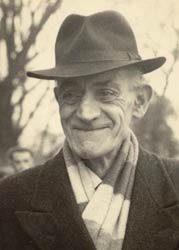 |
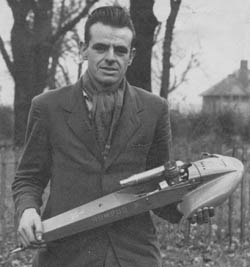
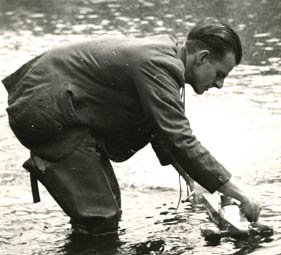
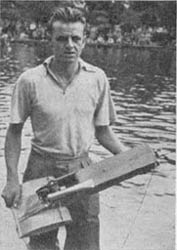
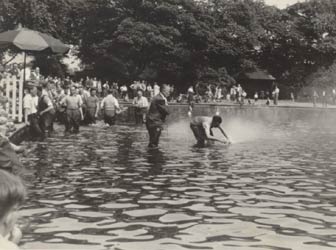
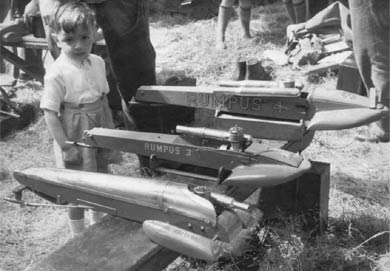
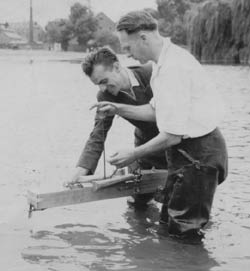
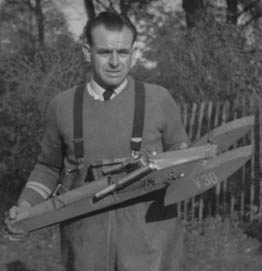
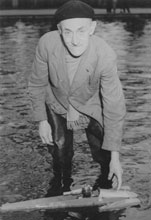
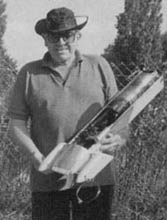
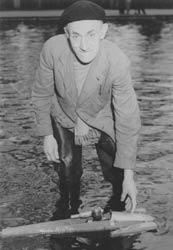
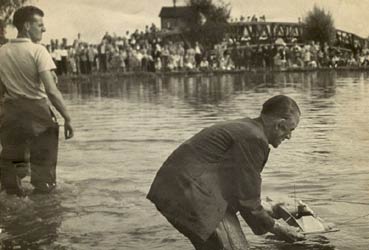
| Harry with Rumpus | Harry and Stan at Longholme Lake , Bedford in 1951 | Harry at Victoria |
|
|
As speeds increased they resorted to using a tripod set in the pond to run the boats on a circular course. In those days 10-15mph. was considered good, always provided the three laps required were completed to record a time. It was my responsibility to look after the boats when they had finished running and father and company had adjourned to the Swan public house across from the pond for a well-earned pint. What kind of introduction was this for a 6-7 year old to the world of modelling? Due to a house move in 1936 the boating activities had to take a back seat in favour of house renovation, and did not resume until 1941-2 when a work friend informed me that he had seen model boats going fast at Victoria Park, Hackney. Being a ‘know all’ 15 year old I said that I knew all about these and had one at home. Between us we resurrected Pop’s old boat and had a few runs on a small pond in Edmonton, North London. Left: Stan in 1950 with Rumpus 3 |
|
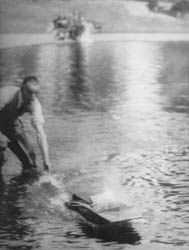
This show of interest sparked Pop’s enthusiasm again, and as I had limited access to some machine tools we built between us a twin cylinder slide valve engine based on the Stuart Turner Sun-Star engines. This had a bore and stroke of ¾ inch and was driven by the 1931 Yarrow water tube boiler and blowlamp from the old boat. The plant was installed in a zinc hull with soft soldered joints and provided many hours of running on the pond at Broomfield Park, Palmers Green, North London. During 1942-3 we embarked on the construction of a flash steam plant comprising a twin cylinder engine with slide valve steam admission, this plant was installed in a conventional hull and boilered by about 30ft. of solid drawn ¼ inch dia. 20swg mild steel tube fired with a pressurized torch type blowlamp. This engine is still in existence, and by today’s standards the construction is a crude fabrication of metal components, the bore and stroke of 7/8 inch, a water pump with 3/8 inch bore, twin oil pumps and generously proportioned components created a monster engine of interesting construction but totally unsuited for flash steam operation. It was the best we could manage at that time. |
 |
In 1943-4, I was dragged kicking and screaming into the Army and eventually came to rest in the REME stationed in Palestine. Here I made use of off duty time designing a twin cylinder poppet valve engine for flash steam, and attending every mechanical engineering course available, and was eventually released in 1948 with a reasonable academic knowledge and a fair degree of practical experience. No information was recorded of the above events, as we did not join the Victoria Park Club until 1949 having been forcibly ejected from the local ponds due to excessive noise from the models.
IC Interlude
We became a bit disappointed with the lack of success with steam plants and purchased a McCoy 60 glow plug engine recently imported from USA, for the princely sum of £14 from H J Nichols of 308 Holloway Road, North London. This engine gave instant success and performed well in the 1950s-60s giving consistent speeds of 45-50mph. Gaining a number of first and second places at MPBA regattas, a later version of the McCoy 60 was also acquired which performed better than the first engine, the two were run in Rumpus series of boats for a number of years. During this period a 14cc ‘Sparky’ engine was built and performed reasonably well but not up to the standard of George Lines’ original motor.
|
|
|
|
|
1949: Rumpus 4 had a 15cc engine. |
1950:Stan with Rumpus II |
1954 at Victoria |
|
|
|
|
|
1954.Steve with Rumpus 3, 4 and Canard |
1956:Stan with George Lines. |
1963:Orbit and 15cc 'Sparky' engine. |
 |
 |
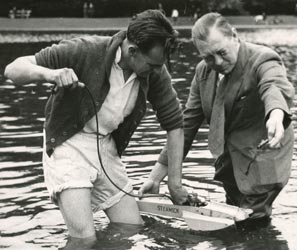 |
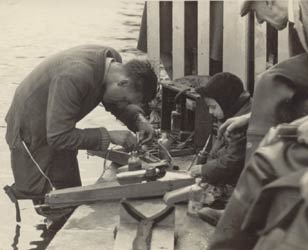
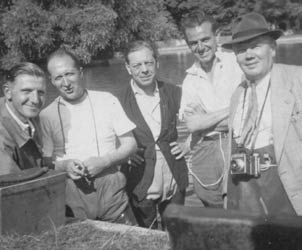
| 1953 Stan, Steve and Pop at Victoria | Everitt, Phillips, Woodley, Poyser, Westbury | 1956 Stan, Steamick & Ted Woodley |
In the late 60s due to a change of responsibility at work, which necessitated travelling the world looking for new plant and machinery for the confectionery industry, the modelling activities had to be curtailed somewhat. By this time however, I had acquired some reasonable workshop plant and was able to produce various bits and pieces without having to look over my shoulder at work to see if the boss was about. My eldest son Stephen, had started work as an apprentice toolmaker, and from a very early age had shown interest in model boating, building a 5cc engine at just 12 years of age, so the third generation of ‘Poyser hydroplaners’ was on the way.
Serious about Flash Steam A and B Class Tethered Hydroplanes
In 1987-88 I was informed that 100mph had been achieved with a flash steam hydro. Now that the pressure of work had eased off I started to think about having another attempt at the mysteries of flash steam and extracted the notes of the previous years and saw immediately where I had been going wrong, and set about building an ‘A’ class engine based on the Bob Kirtley design. Ian Berne of the Victoria Club was most helpful at this stage as Bob had yet to publish his excellent articles in the ME.
|
|
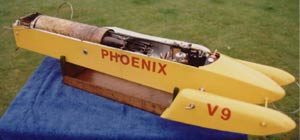
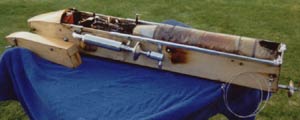
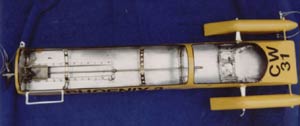
When the plant and hull were completed, I looked around for a suitable name for the model and came up with Phoenix, the mythical bird rising from the ashes. There have been six Phoenix versions to date, all of which have been reduced to ashes due to the excessive heat from the boilers (more of this later). I was surprised to see how close I was to Bob’s layout and to all practical purposes the plant was the same. The best speed achieved with this model was 86mph. Left
top: The 1st
'Phoenix' A class boat |
Above: |
|
|
In 1991-2 design was started for a ‘B’ class flash steam hydro in an effort to increase the existing ‘B’ class flash steam record of about 60 something mph. The ‘B’ class engine embodied several departures from the original ‘A’ class unit in order to be lighter and to improve the construction.
|
|
Every engine/boat builder incorporates their own interpretation of how it should be done, at the same time they should look at the competition and listen to their contemporaries, as they may have tried the proposed changes without success. With this in mind the original concept was maintained i.e. the valve-actuating cam mounted on the crankshaft, but the pump drive transferred to the forward end of the engine and driven by the crankpin. In addition, the drive gear would be machined to provide infinite adjustment to the pump stroke, as opposed to the time-honoured disc with a series of offset holes to facilitate adjustment. At this point I feel I should inform the reader of my passion for machining metal, I find it to be satisfying to transform a solid chunk of metal into an operational component. Photo courtesy Jim Free |
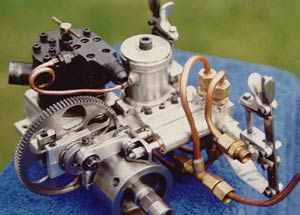
During the design of the engine I decided that all major screw threads would be screw cut on the lathe to ensure concentricity, accuracy of thread form and correct alignment of components. The engine is of conventional construction with a bore of 1 inch and stroke of 5/8 inch, which gives a capacity of a little over 8cc. The crankcase is machined from solid Dural, as are the crankshaft bearing housing, front crankcase cover which also carries the water and fuel pump drive gears and bearings. The crankshaft is machined from a lorry half shaft scrounged from the local garage and the crank pin is 3/8 inch dia. HSS tool-bit pressed into the crank-disc. The con-rod is machined from titanium and fitted with a phosphor bronze little end bush with a needle roller bearing fitted to the big end running on the tool steel crankpin.
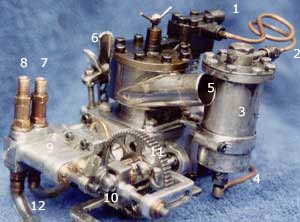
Anatomy of a record breaking 'B' class flash steam hydroplane engine.
|
1 Steam inlet to poppet valve. 2 Oil feed to valve chest. 3 Displacement lubricator. 4 Pressure feed to lubricator. 5 Exhaust from cylinder. 6 Hand water 'priming' pump. |
|
7 Water pump feed to steam generator. 8 Fuel pump feed to burners. 9 Fuel and water pumps. 10 Adjustable scotch crank. 11 Reduction gear for pump drive. 12 Fuel and water feedpipes. |
The cylinder barrel I machined from mild steel with a mehanite liner. Six exhaust ports are equi-spaced round the barrel at bottom of the piston stoke to provide the uniflow exhaust. The exhaust steam is collected in a steel jacket surrounding the cylinder, and then discharged to atmosphere via a silencer, which reduces the noise level to an acceptable level. A hydrostatic lubricator provides lubrication to the valve and upper cylinder and, to date, this system has not failed under normal working conditions. Lubrication to the internal components e.g. conrod, crank pin, crank shaft bearings, pump drive and cam is catered for by ‘splash’ lubrication from oil within the crankcase.
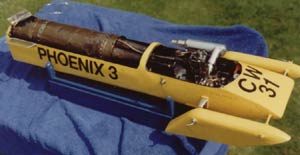
The monotube boiler and burner arrangement on this model consists of 18ft. of ¼ inch dia. x 20swg stainless steel tube formed into a coil with the burner vaporizing coil formed from 3/16 inch dia. x 20swg stainless steel tube positioned inside the boiler coil. The whole assembly installed inside a .010 thou stainless steel casing. There are three burner nozzles mounted onto the front end of the boiler wall, the nozzles carry the mounting for the jet block which houses the three burner jets. The outlet end of the casing is formed to an upward swept opening to provide discharge of burnt gases from the burners. During the running of the A class boats, severe burning and scorching occurred in the boiler area of the hull due to the removal of insulation from the boiler casing to stay within the 16lbs weight limit for the class.
|
With this problem in mind it was decided to construct the new hull from 24 swg aluminium, which presented a few difficulties in arriving at a reasonable shape and making the hull watertight, while at the same time keeping within the weight limit of 8 lbs for ‘B’ class steamers. All joints were coated with Araldite and riveted, which was a messy undertaking, but the completed hull looked reasonably good. Stress points were reinforced by double plating the areas concerned, and the all up weight came in at 7 lbs 14 ozs. Phoenix 3 had its first outing at South Cerney in 1993 and recorded a speed of 56mph. Gradually over the following two years this was increased to about 75mph by making adjustments to the engine, pumps, planning angles and burner jets. The greatest problem was to make a propeller that would suit this hull-plant combination. Eventually the hull of Phoenix 3 suffered from metal fatigue, with cracking occurring at the sponson attachment points and engine bearers, so in the interests of safety was withdrawn from racing at the end of 1995. |
|
|
|
 |
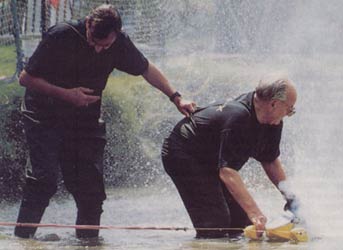 |
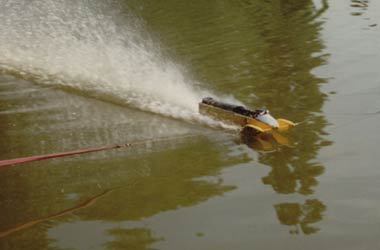
| Phoenix V in 1997, just after launching on a run. | Stan and son Steve at the 1998 Amiens International. |
At the 1998 Amiens International Stan and Steve gave a demonstration run as B Steam is not run in competition on the Continent The red cord seen towards the left of each photo is an elastic 'bungee' to aid the launch of the boat.
|
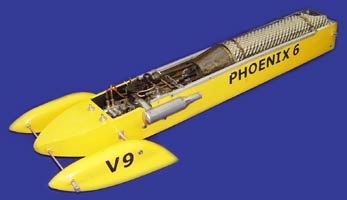
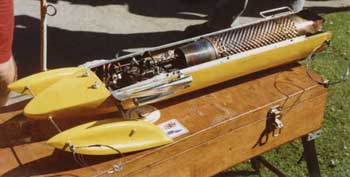
The next hull followed normal construction being built on plywood frames with ¼ sq birch stringers and clad with 1/32-inch marine plywood. In order to reduce the scorching problem an increase in permitted weight to 9 lbs was requested and approved, this change enabled the hull to be ½ inch wider and 3 inches longer improving the airflow around the boiler, which reduced the burning problem. Speeds started to move upwards and on one occasion at Farnborough five consecutive runs were recorded in excess of 85mph. At the St Albans International regatta on August 2nd 1998 a record for the class was established with a speed of 96.6 mph (from this point onwards things started to go downhill). 'Phoenix 6' is the only boat of the series that has survived complete. |
|
|
The start of the 2001 season prompted me to try a different hull shape, this was to be half round in section on the underside tapering to a pointed nose in an effort to spill air build up under the hull and reduce the possibility of lift at high speed which had been in evidence on the previous hulls. Following a number of poor runs during 2001-2003 it was decided to take this hull out of use and think again about the future. However, age and physical constraints were beginning to creep up on me, and it was reluctantly decided to end active power boating, sell off the workshop equipment, and move to more manageable living accommodation. This was the seventh boat in the 'Phoenix' series but never named. Photo: Late Jim Free |
|
Reflection
|
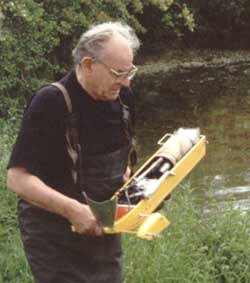
Between 1990-92 six first places and nine second places were confirmed at MPBA regattas for the ‘A’ class model, with the highest speed achieved being 86 mph. From 1993 to 2003, I achieved 23 first places, one second and one third place at MPBA regattas with the ‘B’ class model, the highest speed being 96.6 mph. A fair amount of test runs were made on the Bradwell pond in Essex, and my personal diary of events show the speeds to be generally between 85-90mph. The magic 100 mph eluded me. I think in fairness it should be observed that the number of first places with the ‘B’ class model came about because no other steamers in this class were in opposition. I was challenging myself in order to raise the performance of the models. Right: Stan at Farnborough in 1997, photo by the late Vic Collins |
|
In the late 1980s when my interest was resurrected Stephen renewed his involvement, and was successful with 10cc OPS engined boats recording speeds of 110-120mph on several occasions. Steve's two sons Andrew and David also started competing during this period and won prizes at the ages of 12-14, running in the novice class. As the years advanced, they both became engaged in more 'normal' teenage pursuits, and while still interested do not participate.
Steve has continued to run 10cc and 6.5cc boats, keeping up with the front-runners in both classes. With the recent introduction of 7.5cc engines, he now runs two boats in this class, and in conjunction with Terry Everitt was responsible for the construction and placing of the tripod in the lake at Althorne.
|
|
|
|
|
|
|
Four generations of the Poyser tethered hydroplane dynasty. From L-R: Harry (Pop), Stan, Steve, Andrew and David |
||||
During the 60 odd years of power boating I have had the pleasure of meeting some first class model engineers some of whom have recorded their trials and failures in the pages of the Model Engineer. I refer with admiration and respect to Messers Cockman, Pilliner, Bamford, Jutton, Benson, Rayman and Kirtley. To readers who seek more information on the subject of Flash Steam, I recommend the following publications: Flash Steam by E T Westbury, and Experimental Flash Steam by J H Benson & A A Rayman.
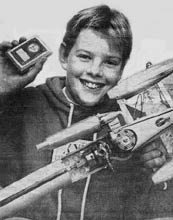
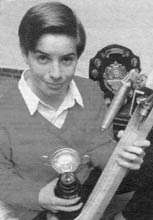
Update April 2011: Sadly, Stan died at the end of March. He had been of immense help to OTW, not only in preparing this superb article detailing his involvement in tethered hydroplanes, but also in giving us access to his extensive archive of photographs and engine collection. With his detailed knowledge of precision engineering and hydroplane racing he was always willing to answer questions and put us on the right track, especially with anything relating to flash steam and those that pursued that path. Stan was the long standing President of the Model Hydroplane Club and has held the B/Steam record from 1998 to the present. Another valuable link with the past is no more, and we pass on our condolences to the Poyser family. Photo courtesy of Terry Everitt
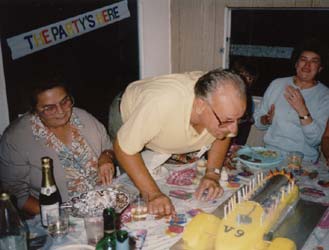 |
Stan W Poyser 1926-2011 Obituary. By courtesy of Dennis Mattingly Stan Poyser’s interest in model power boating started when he was about seven years old. This was when he accompanied his father, Harry ( Pop ) Poyser, on Sunday morning outings to Clapton Pond, Stamford Hill, North London. He said that his main involvement at this time was to stand guard over the boats belonging to his father and friends when they retired to a nearby hostelry. However, Stan’s first hand involvement with power boats really began when he was about 15 and he persuaded his father to power up one of his boats, that had been long dormant, for one of his friends. This demonstration was carried out in a bath-tub in the garden of their house. The wash from this huge machine nearly emptied the bath. |
This experience reawakened enthusiasm for the hobby and Stan then put on waders ready to leap off the pond’s edge to prevent a twenty pound hot steaming monster crashing into the bank at 20 miles an hour. It was around this period that Stan began his engineering work and machine shop experience when he was employed in several shops until he was called up. He was first conscripted into the Royal Artillery then eventually spent his time in R.E.M.E. workshops where he took full advantage of the various technical and trade courses on offer. Stan was posted out to Palestine and was there for most of the remaining time of his service. On leaving the army he was offered a job with a well-known confectionary manufacturing company as the maintenance engineer. The many skills that he had by then acquired fitted him well for this job and he showed that he could provide methods that would improve production for the company. He later was to become Chief Engineer to the company.
Stan started making his own engines when he first was able to get his hands on machine tools making parts with or without the foreman’s permission until he was able to get a machining facility of his own. His first lathe being home made by him and his friend. He made many engines and built a number of boats during the sixty plus years he was active in the sport, several of these are to be seen at the M.E. exhibitions. He found immense pleasure in trying to solve the problems associated with flash steam and was always seeking ways to resolve these. Stan has written of his engines and boats in OTW where also are recorded some of his experiences with flash steam boats. He chose the name `Phoenix’ for his last series of boats. He had hoped that he might be able to get one of these to reach 100 mph. Unfortunately he never quite achieved this but the last of these, Phoexix 6, set a record for ‘B`Class flash steam boats at 96.6 mph. This was in 1998 and still remains the record for this class of boats.
Stan continued to pursue his aim until around 2003 but then was forced by age and health to cease active participation in the sport. Nevertheless his interest never wavered, he was pleased to enjoy his membership of the Victoria Park Club and was honoured to be President of The Model Hydroplane Club.
Our thanks to Dennis for this appreciation of Stan's life
©copyrightStanPoyser2007
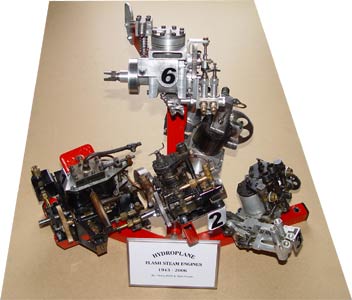
Flash Steam Engines from the Poyser Family
These engines represent sixty plus years of work and development in the field of flash steam, starting in 1943.
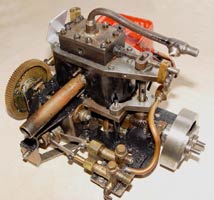
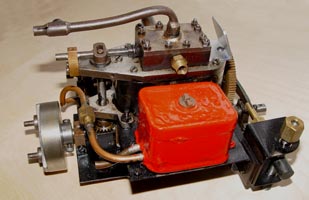
No1: Built in 1943 by Harry Poyser. Twin cylinder ⅞th inches bore and stroke slide valve engine fabricated from steel and bronze. All components were cut and fashioned by hand, with the exception of the pistons, cylinders and flywheel. This plant was installed in an ‘A’ Class, single step, submerged propeller hydroplane. Steam for the motor was provided by 30ft of ¼ inch dia x 20 swg mild steel tube fired by two pressurized burners. It was never very successful as it failed to complete the three laps required to record a time, the best speed being about 40 mph.
 |
 |
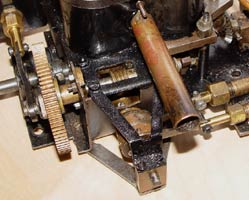 |
| Twin eccentric driven oil pumps | Scotch crank valve drive | Water and oil pump reduction gears |
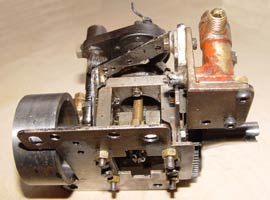
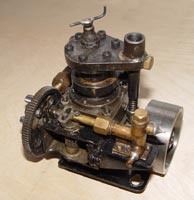
No2: Built in 1944 by Stan Poyser. ¾ inch bore and stroke poppet valve, single cylinder engine fabricated on the same principle as engine No 1 and installed in an ‘A’ Class hydroplane as described above.
 |
 |
 |
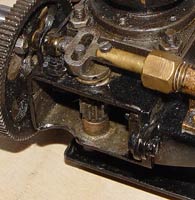 |
| Inlet cam on crankshaft |
Open crank design |
Spur gear, worm and wheel double reduction oil pump drive | |
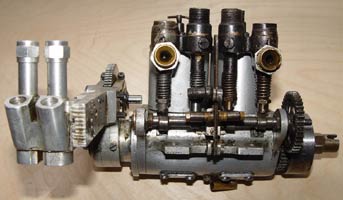
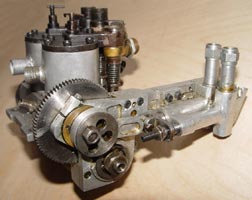
No3: Built in 1948 by Stan Poyser Twin cylinder ¾ inch bore and stroke with poppet valves controlling steam inlet and exhaust. This unit is fitted with an automatic advance to the inlet valve by a tapered wedge between the cam and valve. This reduced the valve clearance and increased the lift, thus adjusting the opening and closing period of the valve. This unit was installed in an ‘A’ Class boat following the layout of the previous models.
 |
 |
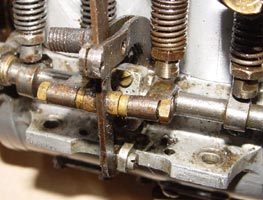 |
| Four cams, four poppet valves | Variable throw eccentric for pumps | Mechanism for varying vale timing |
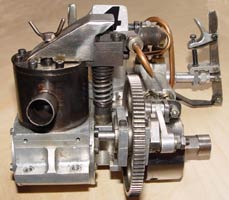
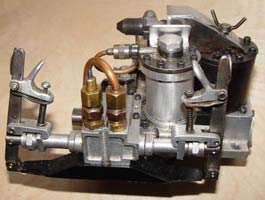
No4: Built in 1988 by Stan Poyser on his return to flash steam competition. 1¼ inch bore, ¾ inch stroke single cylinder engine with poppet valve for steam admission and uniflow exhaust. Steam generated by 30ft of ¼ dia x 20 swg stainless steel tube, fired by three burners fuelled by an engine driven fuel pump. This plant was the first of the series of ‘Phoenix’ hydroplanes, and achieved a best performance of 86 mph.
 |
 |
 |
| Pumps on drive side of motor | Manual fuel and water pumps | Micrometer adjustable pump throws |
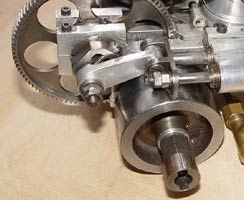
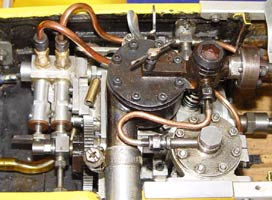
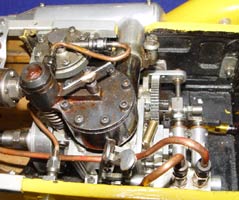
No5: Built in 1992 by Stan Poyser and currently installed in ‘Phoenix 6’. 1 inch bore, 5/8th inch stroke, poppet valve steam inlet, uniflow exhaust single cylinder engine. Installed in a ‘B’ Class, surface propellor hydroplane and powered by 18ft of 20 swg stainless steel tube, fired by three burners fuelled by and engine driven pump. ‘Phoenix 6’ currently holds the British B/S class record at 96 mph.
 |
 |
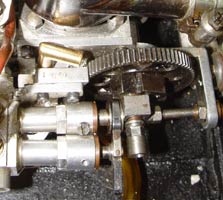 |
| Small toggle disconnects fuel pump to allow manual operation during boiler pre heating operation. Seen directly above | ||
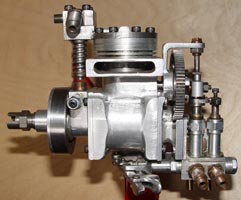
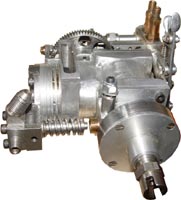
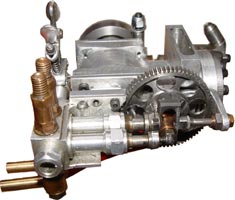
No6: Built in 1998 by Stan Poyser. 1 inch bore, 5/8th stroke horizontal single cylinder with poppet valve steam inlet and uniflow exhaust based on the design of the engine in ‘Phoenix 6’. Intended to be installed in the stern of a ‘B’ Class hydro with the burners and boiler at the front in order to improve the airflow.
 |
 |
 |
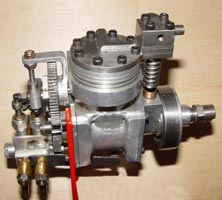 |
| Pumps and reduction gears have been turned 90 degrees relative to the engine. Monobloc crankcase used in this motor for first time | |||
|
Steve undertook the task of cleaning and renovating the entire collection of flash steam engines that had been retained since the very first example. He then produced this sculptural display stand that shows all the engines in a most attractive manner including key numbers that refer to information sheets and the numbers above. With a large, purpose built carrying case these engines have been displayed regularly at model Engineering Exhibitions Thanks to the late Stan and Steve Poyser for the loan of this wonderful display and for the accompanying notes |
|
©copyrightOTW2010