| Baxter's Miss Swindon |
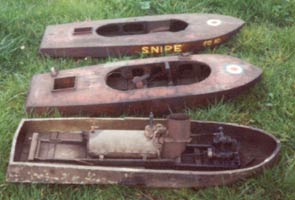
Waterton's Tally Ho |
Everitt's Swinging |
Lowne 'Otter' |
| Noble Bulrush 9 |
ED Challenger |
Owst 15cc |
Lambert's Rhumba 5 |
| Clifford rev counter |
Clifford's Hell's Bell's |
6 Booth boats |
|
|
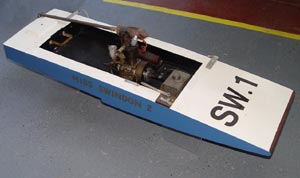 |
As simple as it gets? A rectangular single step
hull with a F.N. Sharpe/Grayson 25/30cc four stroke bolted to bearers on
top of the step. The step is unusually far back and with the battery at
the stern should have proved fun when it came to getting the hull
balanced. The second of the boats built by Mr Baxter to carry the Miss
Swindon name. Part of the late Gerry Colbeck's collection of vintage
hydros that have resided at Pitsea.
June 2010 Photo OTW |
|
 |
'Tally Ho' As the smaller classes using commercial
motors became more popular through the late 50s and into the 60s, the
numbers competing in 'A' Class dwindled. One person that was ever
present was Frank Waterton with 'Tally Ho'. Frank
built
engines of the highest quality, and was probably best known for his
amazing 6 cylinder motor. 'Tally Ho' was an extremely large boat by any
standards and the motor was remarkable for its 3 transfer covers. The
boat was part of the Pitsea collection until the closure in 2009.
OTW 2010 |
|
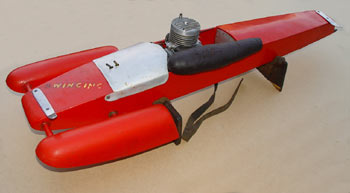 |
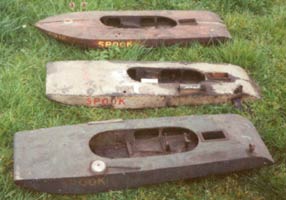
Bill Everitt's 'Swinging' After campaigning the
'A' Class 'Melody' very successfully for many years, Bill built a new
30cc hull for the 1962 season. Almost from the first outing it was
running at 70+mph and went on to record numerous regatta successes
through to Bill's untimely death in 1964. 'Swinging' was seldom beaten
if it was running to form, winning the International, Grand and regional
championships. Although coming up for 50 years old, a little TLC should
see this vintage 30 circulating again. Thanks
to Terry Everitt for making the boat available. April 2010 |
|
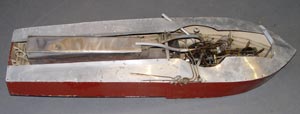 |
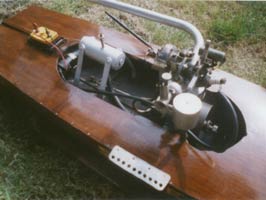
'Otter' In the late 1930s and through
the war years. Fred Lowne of the Blackheath Club who owned an instrument
company in Lea Green built a series of flash
steam engines, notable for their ingenious valve gears. The smaller
engine that he built for his 'C' Class boat 'Little Otter' had a piston
valve operated by two overhead camshafts with complimentary profiles.
Almost desmodromic in a way. At only 9/16th bore this little engine
could manage over 25mph, at which stage the hull became completely
unstable. A three cylinder radial that he displayed at the Blackheath
exhibition in 1941 used pushrods and bell cranks to operate the valve
gear, but still with two cams at opposite ends of the crankshaft. This
is his 'B' Class 'Otter' that uses the same valve gear as the radial,
but with just one cylinder. Like many flash steamers, it takes a while
to work out all the plumbing. Otter, Water Otter and variations were
names regularly used for FS boats, being a play of words.
March 2010 Photo OTW |
|
 |
|
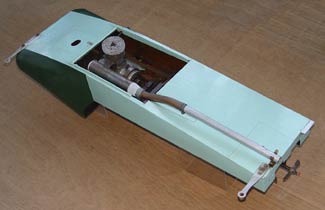 |
Bulrush 9 The Noble brothers started running
hydroplanes in 1911 and George continued to compete through to the
1950s. Noble boats showed all manner of interesting developments in hull
and engine design with two-stroke, four-stroke and flash steam power.
The most successful was Bulrush 8, probably the most conventional, but
its post war successor shown here used integral sponsons, while the
underneath portion of the hull was quite radical. The simplicity of the
two-stroke motor installation is in marked contrast to the complexity
of Bulrush 8. Sadly, the damp in the museum has wreaked havoc with the
magnesium on the engine.
Feb 2010 Photo OTW |
|
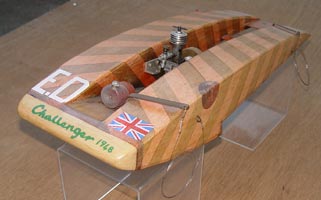 |
ED Challenger. Probably the most common of the commercial hydro
kits to have been built. Based loosely on George Stone's 'Lady Babs' and
marketed by ED from 1948, it was not intended for racing as it did not
fit any of the existing classes. Most were fitted with 2cc ED Comp
Specials or similar, although the one that turned up for sale at Bilston
had a 2.46 Racer. Performance is so marginal that steel cables are too
heavy for it to pull round. Not impossible to find kits or hulls on the
market.
Thanks to Peter Hill for the loan of another of his
fascinating vintage boats. Jan 2010 |
|
 |
Another 'boat in a box'. This lovely boat was
built around 1950 by Norman Owst of Leicester. Better known for his
model locomotives, this seems to have been something of an engineering
exercise, as it was a boat 'out of its time'. The hull is a lengthened
version of the pre war Westbury 24" design with the addition of two
sponsons to the single step. The motor is a well engineered 15cc
Westbury KIWI. Ignition is via a magneto that is part of the prop shaft,
which also drives the oil pump. There is no record of the boat having been run but
the motor did run quite happily before the boat was loaned to Pitsea. It
also comes with a very large carrying box!
Thanks to Peter Hill for the loan of the boat Dec 09 |
|
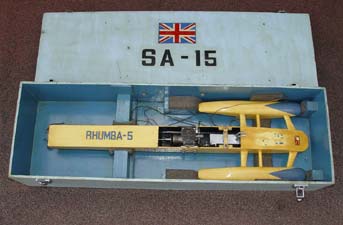 |
Another Peter Lambert gem. Peter Lambert did a
great deal for tethered hydroplane racing and the St Albans Club. In
order to encourage more people to participate, he and Ken Hyder came up
with two standard designs for 5 and 10cc motors that would prove
to be extremely successful. The Lambert/Hyder hydro won numerous races
when it was a current design and later copies have proved to be equally
fast in vintage competitions. This is the 5cc version as it last raced,
with flax bridles and its fitted carrying box.
Thanks to Nigel Lacey for loaning the boat to OTW. Nov 09 |
|
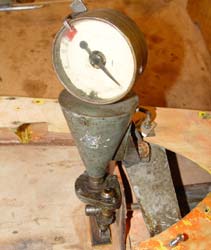 |
'Counting the revs'? Getting the maximum
performance from a motor depends on knowing what revs it is doing on a
particular prop. Many ideas were used, including analysing photos of the
propwash to count the turns of the prop, a flashing light geared down
from the drive shaft, or even a little flag, again geared to the shaft
that rose and fell and had to be counted. These devices were very
approximate and depended on accurate counting throughout the lap.
Stan
Clifford came up with this mechanical 'rev counter' that indicated the
engine speed on a dial facing the outside of the circle. Here it is seen
in 'Hell's Bells', geared driven from the prop shaft. Remarkably, the
red sector on the dial starts at 20,000rpm.
Thanks to Norman Lara for preserving
this piece of 'hydroplane history'. Oct 09 |
|
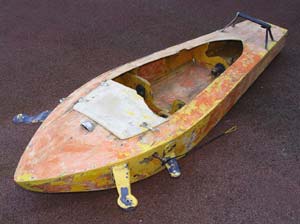 |
Mortal Remains of 'Hell's Bells'. This is the hull
of the last boat that Stan Clifford built, 'Hell's Bells'. At some stage
it had been stripped out and a start made on removing the paint, and
this is how it has remained. The engine and most of the bits are still
in existence, but restoration of those and the hull are going to be major
undertakings. It is hoped to be able to bring you the complete story of
Stan's long and illustrious career with tethered hydroplanes in due
course, as well as progress on the task of restoring the only boat of
his to have survived.
Thanks to Norman Lara for making this item available.
Sept 09 |
©copyrightOTW2009