|
Home Updates Hydros Cars Engines Contacts Links Contact On The Wire |
Bill Everitt's 'A'
Class hydroplanesNo matter whether it is cars, boats, planes, engines or trains, full sized or model, at some stage in their lives they will fall out of fashion and the process of decay starts. Burned, scrapped or left to rot, the end is inevitable until someone suddenly realises, that once they are gone, that is it. Happily there are always individuals or groups that will step in before it is too late, but even then, with the best will in the world, the decay continues because the preservation, conservation or restoration never happens. Tethered cars are not too bad in this respect as it is normally only the tyres that suffer, but boats are a different matter. Wood, oil, water, petrol, methanol, battery acid and physical size have meant that far too many have ended up as bonfire material, and others are well on the way. It is one of my aims to prevent this happening as far as is realistically possible, and this is how that came about for two very well known hydroplanes that had been built by Bill Everitt.
'Melody'
|
|
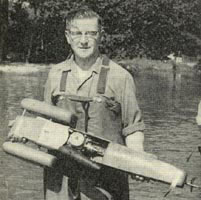
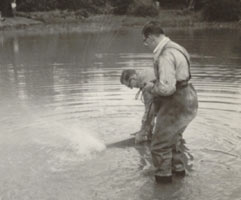
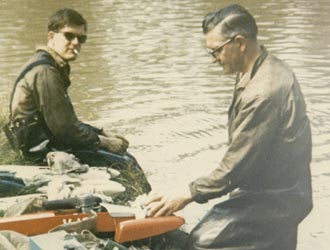
Some years ago I was shown an otherwise complete hull that was minus its engine. It was Bill Everitt’s ‘Melody’, a very successful 30cc A Class boat that he had raced throughout the 1950s, gaining several prestigious race wins in the process. He built and ran a whole series of 10 and 30cc boats during his competitive career, yet 'Melody' was the most consistent of the 30s. Following Bill’s sad and untimely death in 1964 the boat passed to his son Terry, who loaned it to Peter Hill in the early 90s to run in the vintage class. 'Melody' was without its original 30cc two-stroke that Bill had built from a set of castings that he and Ernie Clark, also of the Victoria Club, had produced, as that had been used in a later boat. As a result, Peter fitted an American 30cc motor that had been given to him by Charles Watkins. Bill Everitt seen here in 1963 with his later A Class boat 'Swinging' |
Whilst the Watkins engine would run happily, it never produced the same level of performance that Bill Everitt’s motor did, probably because the Americans used to run with huge loads of Nitro and probably a bit of propylene oxide to help it along.
|
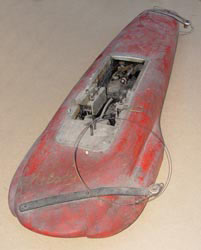
After three seasons of running this true 'vintage' boat, Peter moved on to other projects and ‘Melody’ was consigned to the workshop loft, where I first saw it some 10 years later. With its history, it seemed a very appropriate candidate for conservation and I investigated the possibility of restoring the hull and reuniting it with the original engine. Thanks to Terry and Peter, a couple of years later I was able to progress on the first stage when I picked up the hull. The next bit is always a dilemma, how much work needs doing? I like to keep everything as original as possible, but sadly, the ravages of the oil and water, plus a strange reaction between layers of paint meant that this was a major job. Right: Melody as recovered |
|
|
|
The hull is based on a Bob Palmer design
with two thick hardwood frames running the length of the boat, Lime hardwood bow
and stern blocks, and then everything else balsa, except for the floor and
sponson planes of ply. Here was the major problem. The ply floor had split at
some stage and oil had migrated throughout the middle core of the three ply, but
by a stroke of luck had not contaminated the balsa, so a new ply bottom was the
first stage. Having stripped off the ply, all the fittings were removed for
cleaning and repainting and the inside cleaned up using thinners to leach out
any oil in the hardwood. Fitting the new floor required some real finangling as
this would normally go on before the balsa blocks, but careful fitting and
plenty of glue got us there in the end.
|
|
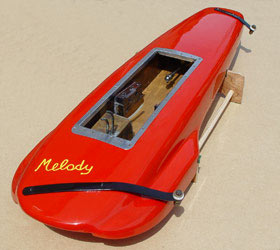
The rest of the hull was a different matter as something had reacted with the top coat of paint, which was blistered and peeling so had to come off, but I wanted to keep the name and was aware that the surface of the hull is doped nylon, so had to be most careful. With a lot of rubbing down and priming I was able to apply several coats of red International Yacht Paint as instructed by Terry. To preserve the name I rubbed each coat back to the sign writing each time until the paint was transparent. With a tiny brush and shaking hand the name was picked out in yellow enamel.
|
|
|
|
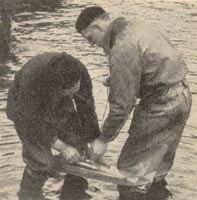
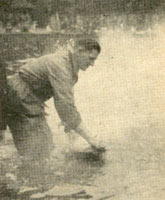
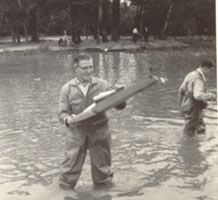
The metal work was relatively simple, except for the cockpit surround. Just a small piece of this remained to show how it had been. The entire surround was cut from one piece of aluminium sheet, the centre cut out and then flanged to fit the opening. It also has to be curved as well in two directions, just to add to the fun. Left: Bill Everitt Launching 'Melody'
at Wicksteed Park in 1957. |
|
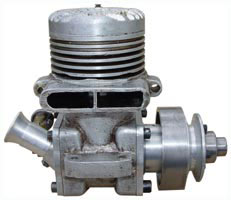
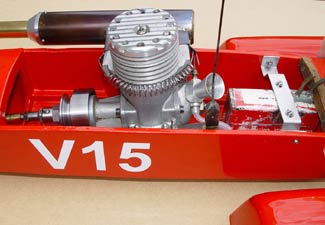
New screws and plugged holes allowed the skeg and tether brackets to be reattached securely and there was ‘Melody’ back to pristine condition and hopefully safe for the time being. The only problem at that stage was the lack of a suitable engine. I had seen and photographed the original motor some time previously and still harboured the hope that I could bring the two back together, which is why I was reluctant to refit the Watkins engine used in the 90s as that was physically much bigger. Original motor that powered 'Melody' and 'Swinging' to so many victories. Courtesy of Terry Everitt |
|
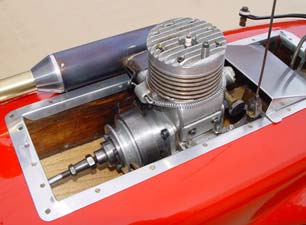
It was in this state then that OTW originally featured 'Melody' as a Workbench project late in 2009. Terry Everitt then very generously offered me the motor so that the boat could be completed with a view to it being exhibited at the 2010 Model Engineer Exhibition. This required some swift work to meet the deadline for collection. A great deal of time was saved through Terry still having original engine plates along with the nuts, bolts and spacers. The longest job was a silencer, similar in design to the original, but with additional baffling to meet the modern noise limits. One feature of all vintage boats was a fuel cut-off that was tripped at the end of the run. The original had not been used in the 90s but after some repairs was able to be refitted The last item was an aluminium spray shield folded up to pick up on the screw holes in the side frames.
 |
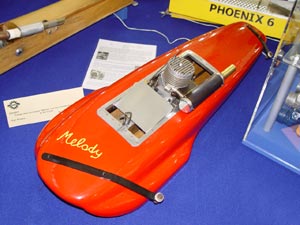 |
It has taken a few years, but thanks to the generosity of Terry Everitt and Peter Hill and the continuing help from Terry, my ambition to preserve 'Melody' has been realised. Terry did however issue a strict proviso when passing on the motor that 'it was not ever to be run again'.
'Swinging'
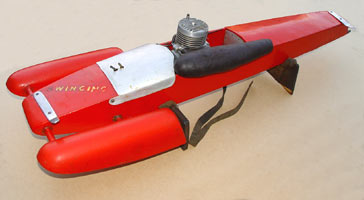
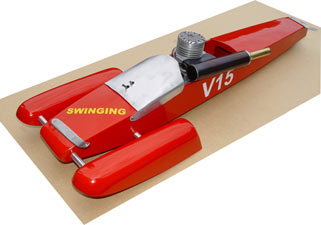
This project started on a trip down to Enfield to pick up the motor for ‘Melody’ ready for the Model Engineering Exhibition. As well as the motor, Terry Everitt pointed to a large hull in the corner and said I could have that as well ‘if I thought I could do anything with it’. It was ‘Swinging’ the second of the ‘A’ Class boats run by his dad, the late Bill Everitt, which we featured in Pitbox in April this year. The new hull was built for the 1962 season to utilise the existing 30cc motor from his previous boat ‘Melody’. ‘Swinging’ as it was named was capable of running at over 70mph and gave Bill many regatta successes over the next two seasons until his untimely death in 1964.
As a restoration this was a complete contrast to the mammoth task undertaken with Stan Clifford’s Hell’s Bells. In many respects, what I have finished up with looks little different to what I started with, but that hides a great deal of work.
|
A named boat with a history is always an attractive project and there seemed little that needed to be done until I turned it over. Half of the palm plate was missing, along with a substantial piece of the bottom and one of the frames where the power of the motor had proved too much for the shaft mountings. Water damage had led to both sides of the boat delaminating, presenting me with something of a problem. I popped the original motor back in for a photo call before pondering on what to do. |
|
|
|
I try to keep as much original material as possible, but as the boat was built around these two long lengths of ply, replacing them was not an option as what would have been left would not have been ‘Swinging’. The first stage was to remove the bottom of the hull, which proved to be far more of a challenge than anticipated. Scraping the paint out of a multitude of screw slots kept me amused for a while. Usually old glue joints will come apart with a little encouragement, but this glue was as good as the day it had been applied. The ply had to be taken off the glue bit by bit and then the glue removed by scraping. It transpired that it was Araldite, which must be a good advert for the lasting powers of epoxy. |
|
The rest of the hull was fine so all remedial work had to be done from the bottom, which is not the easiest way to work. Each lamination of the ply had glue pumped into it and then clamped up over a distance of about five inches. Interestingly, the glue came through the faces of the ply when clamped. What had caused the problems with the shaft in the first place was a lack of any supporting structure so a new set of formers, sub frames and reinforcement was glued into place for the shaft. Before the slot for this could be put in, a decision had to be made about a motor. |
|
|
|
As it is intended that this boat will run again and using Bill’s original engine was not an option the Watkins motor that had seen service in ‘Melody’ when Peter Hill was running became available and that was an almost exact fit. The engine plates, bolts and spacers were all reused and soon there was something that looked like a boat, although with a large hole where the bottom used to be. The only work needed on the motor was a smaller flywheel and coupling and a lot of de-gunging. With the motor and skeg in place, a serious session or two with round files had the shaft fitting snugly and then it was a case of varnishing and repainting the insides of the compartments that would be sealed when the bottom skin went on. Terry Everitt with Bill and 'Swinging |
Reasoning that if epoxy was good enough in the first place, that is what I would use, and so an hour or so with very sticky fingers followed, as the myriad of screws went back in. With the bottom trimmed and sanded, the motor and skeg could be re-installed ready for aligning the shaft. I had taken particular care with this aspect so was pleasantly surprised when the shaft slid into both couplings without any binding.
|
I had left all the original paint in place, so it was a matter of filling in the various holes and dings and building up the surfaces where the paint was missing before a couple of coats of International’s finest. Taken aback somewhat when I was informed that International had withdrawn this type of paint, as ‘there was no demand’. Is it back to Japlac or Valspar, or have they vanished as well? New name and registration numbers courtesy of Steve at Humberston Signs and we were nearly there. |
|
|
|
All the original parts for the fuel system were still with the boat, including a very large tank made from an OXO tin that proved to have a couple of leaks. Suitably re-soldered and with a more substantial mount, that dropped back into place perfectly. The size of tank would probably be good enough for 40 or 50 laps so the existing fuel cut-off is connected into the fuel line. This only left a silencer, or lack thereof. The normal method of manufacture at the time was to wrap Gun Gum round a former and manifold and then stick it in the oven, preferably when the wife was absent. I was not going to get away with this and the silencing properties were not up to the standards required today, so I set to and made a entire system that should muffle the motor without affecting performance too badly. |
As well as offering his dad's original motor for Melody, Terry Everitt kindly provided a selection of props suitable for Swinging to enable it to be run at sometime in the future.
Thanks again to the late Terry Everitt and Peter Hill for their generosity and help with both these restoration projects.
©copyrightOTW2010