| Home Updates Hydros Cars Engines Contacts Links Page 6 ←Previous Next→ Pit Box Index |
| Pit Box |
| Westbury 'Golly' engine | Bond's Bonzone | Clement's 30cc | Bond's Simplex |
| Carter Special | Grayson | Speedwell 10cc | Wotzit |
| OPS 'Worthog' | Arkell twin | Gamages Racing motor | Cameron 10cc |
|
|
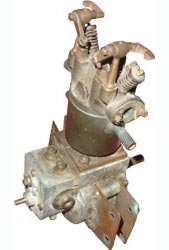
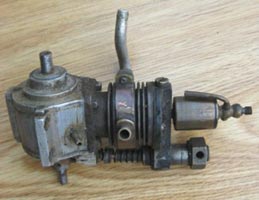
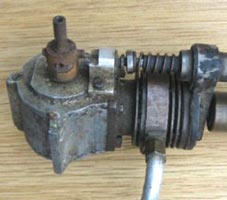
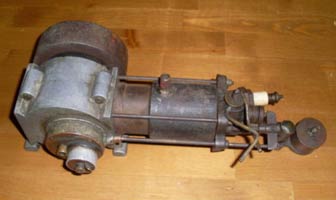
Golly! The clue is in the heading. This is indeed
Edgar Westbury's own, much modified, motor from his hydroplane 'Golly'.
The engine was first described in Model Engineer in 1935 and then
illustrated several times in subsequent years. What makes this discovery
so exciting is that it forms part of a collection of original Westbury
engines and associated material that has been in the families possession
since the death of ETW in 1970. Not only is the provenance beyond
question, but as can be seen, none of the items has been touched in the
intervening period. OTW is delighted to be able to share this item and
in due course will bring you further details of this and of all the
other original engines, as well as anything else of relevance that comes
to light. |
|
|
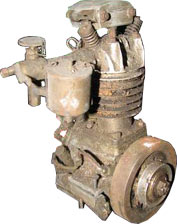
Euston Road Rarity The 'Bonzone' was designed by S.W. Phillips and
produced by Bonds 'O' Euston Road from around 1926 to 1930/31. With its
radial valve head it was a significantly better engine than the Simplex
which replaced it, although it was only a change to a basic parallel
valve head that distinguishes the two motors. It is suspected that it
was the cost of machining the head for the company, or the difficulty of
machining for the home constructors, which decided Bonds to drop it from
their range. The Simplex sold for half the price of the Bonzone and is
still relatively common. This rare example was missing several vital
parts including camshaft, push rods, contact breaker and carb, yet still
sold for over £200. The only other example we have seen had the valve
seats missing the combustion chamber fore and aft and,
for this reason,
remains unfinished . |
|
|
TEC 30 There is something intrinsically attractive about square barrelled motors, whether in full sized or model form. Here is another example from Tom Clement's wonderful workshop, this time a 30cc version, built in the late 1970s. Tom used this motor in his A Class Hellcat boat until it was replaced by the schnuerle ported motor used currently. As well as running his own boats, Tom runs the late Doc English's 15 and 30, which is currently undergoing some renovation. We hope, with Tom's help, to be able to put together a 'Pitbox Special at some stage looking at the background to all these engines. Thanks to Tom Clement for this item. OTW photo. Oct 2012 |
|
|
Definitely 'Euston Road' The 'Simplex' as the name suggests was a more basic motor than the previous offering from Bond's, and cheaper as well. Most of the saving was in the cylinder head, a backward step in performance terms. Even with more advanced head designs, this engine was still woefully underpowered for serious hydroplane work. This is the 'racing' version cast in 'Electron' magnesium alloy, but with a float carburettor rather than the optional racing venturi. Further details of these engines are available on the the Commercial Four strokes page. This item from the late Euan Forbes. OTW photo Sept 2012 |
|
|
|
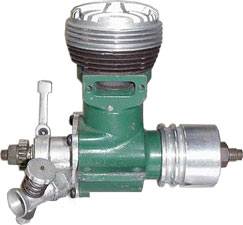
Carter Special Fred Carter achieved legendary status as a tuner of engines for speed flying and team racing. One of the first motors he re-worked was a Nordec before moving on to the McCoys and Doolings that he is best known for. Carter would discard any parts from the donor motors that did not meet his standards, including front and rear housings. Eventually he would built motors that were entirely of his own manufacture, including the crankcases. Thanks to Dick Roberts for photos Sept 2012 |
|
|
Euston Road or Clerkenwell? Identifying these motors is always tricky as almost identical engines were produced by Bonds, Grays and Gamages. F.N. Sharpe is credited with the original design, marketed by Economic Electric, although it appears in several guises from the late 1920s. The bronze cambox is a good guide and a look at the conrod can be most revealing, as the Grayson conveniently has Gray in raised lettering along its length. This example still has the early updraught intake and the screwed in exhaust and intake. It is destined for a period straight running hull, although with a bit of RC to keep it going in the right direction! Thanks to Bill Whitely for this item and photos Aug 2012 |
|
|
Hardly an appropriate name? Another 10cc racing motor that did not
make it. Approximately 12 'Speedwell' 10cc motors were produced down in Rochester, Kent around 1947/48 by well known tethered car racer Ken Robinson. There are some similarities with another engine of Kentish origins, the Pioneer 10, for reasons that we hope will be explored in a more detailed article by someone who knows 'far more about it' than we do. The general opinion is that they were not very successful for a variety of reasons, including porous castings. Of the 12 built, 3 are known to survive and a 4th may be in circulation out there. We would certainly love to hear from anyone who has one of these very rare motors. Thanks to Ken Smith for photos and information. July 2012 |
|
|
|
A 'head scratching' 'Wotzit' This motor did cause a bit of confusion at first, but it would seem that someone has built a uniflow flash steam motor out of either a compressor or an IC motor. The cam on the crankshaft would indicate poppet valve admission, and all in all, it might well have worked. Not sure about the lubricator though? Thanks to Tracey for these images June 2012 |
|
|
Start of a 'dynasty'
This 'as new' motor turned up at a swapmeet and caused a deal of
'head scratching' until a long time tethered hydro and car enthusiast
cottoned on. It is one of the very earliest OPS 60s from around 1970
before the initials appeared on the transfer ports, and the forerunner of
a family of immensely successful motors, many still in use. These early
motors were used in cars and boats, but the Zimmerman disc valve meant
that the motor could not be turned round, resulting in tuned pipes with
U bends. Eventually a new crankcase solved that problem. Mind you, the
OPS and Monza stamped on the lugs should have given a clue to its
origins? |
|
|
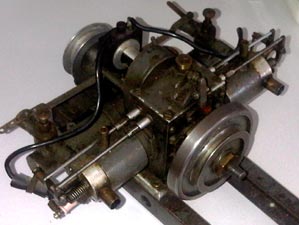
A 'Twin Mystery' This horizontal twin boat engine is completely fabricated, which does give some clue as to its age and possible origins. A similar engine was described in Model Engineer. It seems to be based very much on the work of the Arkell brothers and was rumoured to have some connection with them. The use of pushrod operated inlet valves makes it significantly later than their better known motors. The owner would welcome any help in identification please. Thanks to David Japp for this item and photos. April 2012 |
|
|
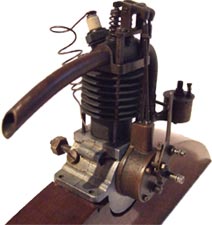
A truly 'vintage' motor This must be one of the very earliest boat motors to ever come onto the market. It was supplied by Gamages of Holborn as a 'Racing Boat Motor' and adverts exist as early as 1913, so it may even be earlier than that. The cast feet show that it was specifically designed to lay flat in a boat hull, although arranging a drive might have proved interesting. A final sale price of £818 was conservative for what might be a unique example of model engine history. Thanks to the vendor for the photos. Mar 2012 |
|
|
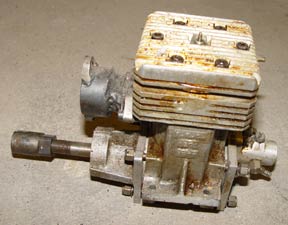
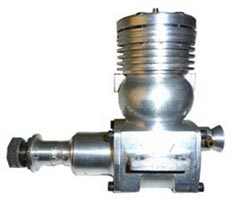
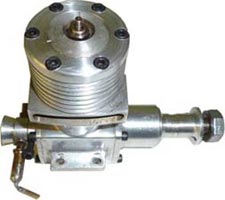
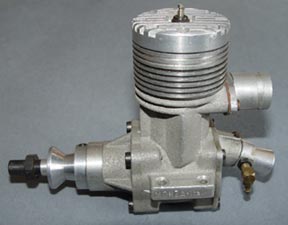
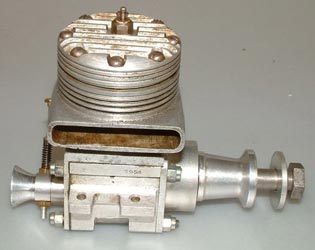
A 'home brewed' mystery Another wonderful example of someone setting to and building a 10cc racing engine from scratch. The separate cylinder with its huge exhaust but moderate transfer passage is bolted to the crankcase via a flange, Hornet style. The choice of round head screws for the cylinder head is unusual as is the fixing of the front and rear housings with studs and nuts rather than screws. There are no clues at all as to who made it although the 1954 stamped on the crankcase flange could give us an idea as to when, making it relatively late. Thanks to John Goodall for this item and photos. Feb 2012 |
|
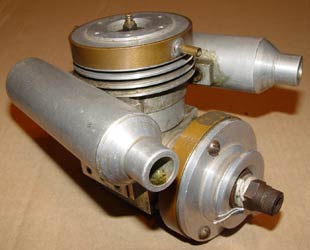
We were missing one vital photo that would have given us a clue as to the maker of this motor as his name was engraved very clearly on the face of the prop driver. Following an appeal for information on the MEN site, the following was received from Sam Alexander up in Scotland. I know the full history of this engine, being the person who first purchased the unfinished motor from Mr. Cameron's daughter sometime in the late nineteen eighties. Mr. Cameron had been a watch maker of some merit with a shop in the small town of Gatehouse of Fleet. In the late forties and early fifties, his hobby was building and running tethered racing cars. At the time I purchased this engine, I also acquired the remainder of his equipment, including hand-built cars, parts and the remainder of his engines - GHQ's Hornet's etc,. all of which have now been sold on. The Cameron engine was the last one on which he worked before he died. I gave it to a good friend who, like myself, was into vintage team racing and was also a qualified engineer. He stripped this motor, reworked it and made some new parts before returning it to me. Over the years I never found a use for the engine so I sold it on my stand at the British Nationals swap meet, about 2006 - 8. It transpires that Mr Cameron was also the owner and builder of two tethered cars we featured some while ago. Thanks to Sam for all this valuable information. Car 1 Car 2 |
|
|
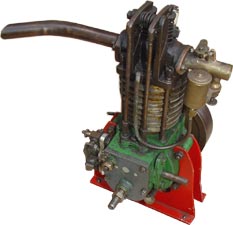
A 'Sparky' motor with a difference This copy of George Lines' iconic design came from the collection of the late Gerry Buck. It follows the published design almost exactly, even to the brass rimmed flywheel. The obvious diversion from the plan is the brass water jacket on the head and a venturi that is significantly smaller than usual. Whether it was originally built in this configuration or altered at a later date is not known, but it must have been a handful in anything other than a hydro. The engine mounting blocks as per George's design would suggest that it was intended for a hydro hull. OTW had to sit on their hands when it came up for auction at Gildings! Thanks to Stuart Robinson for this item. OTW photo Jan 2012 |
©copyrightOTW2012