|
Home Updates Hydros Cars Engines Contacts Links Contact On The Wire |
Pitbox Special
'Ernie' Jackson's cars
Much of what we publish is as a result of various pieces of information that arrive being filed in the memory banks until something comes to light that connects it all and sets us off. There usually follows a period of further research digging out more material to expand what we already have. No HOLMES style computer system just a memory too full of trivia and a lot of archive material. Depending on the quantity of material generated this can lead to a Pitbox feature, a major article, or in this case a shorter Pitbox Special.
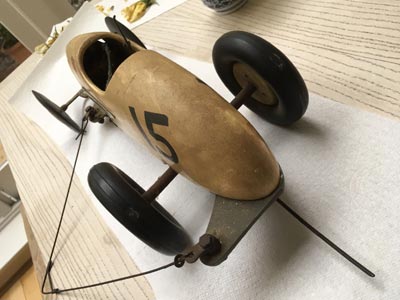
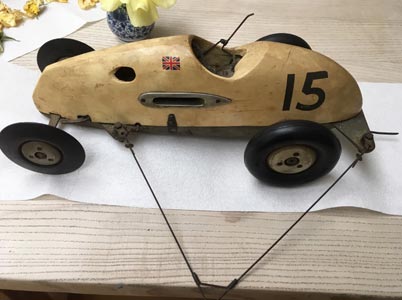
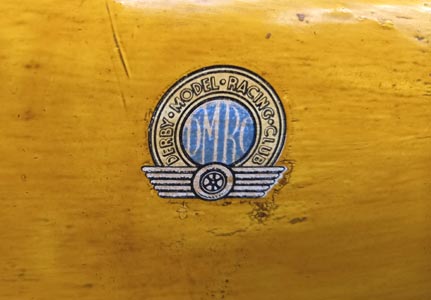
What made this article possible was a simple tie-on label on a vintage tethered car at the BMFA swapmeet last October. We had seen the car the previous year but it bore no resemblance to any cars of which we were aware, and the only identification was a Derby Club decal on the obviously home built Balsa body. This time however it had the all important label tied to the front axle that identified G. Jackson of the Derby Club as the original owner and gave some of the recent history of the car. Here was the key as we had already featured another of Jackson's cars in Pitbox back in 2019 as it was illustrated and captioned in a race report, mentioning that it was of Swedish origin.
 |
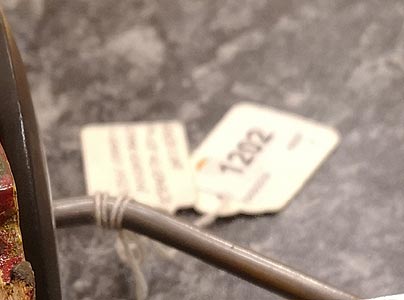 |
| The Derby Club decal in remarkable condition | The labels that revealed the recent history |
|
Not a great deal is known about G.E. (Ernie) Jackson despite him having been elected secretary of the MCA (Model Car Association) when that was established in 1948. His involvement in tethered car racing seems to have petered out in 1952 with the closure of the Derby track and the subsequent relinquishing the secretaryship of the MCA that passed to Ian Moore. Ian Moore, a fellow member of the Derby Club had, with his wife Ivy also retired after an exceedingly successful racing career as well as having published numerous designs. What references we have discovered have allowed us to establish some sort of background to these two cars. |
|
Jackson started racing with what he called 'scale type cars' as was common in the late 1940s, even to the extent of making faux wire wheels that he described in MCN. He was a member of the Derby Club along with Ian and Ivy Moore but the move from the scale cars to the two, full on, 10cc cars appears to revolve around the Anglo Swedish match races of 1949. It was reported that a British team would visit Stockholm in April and would only use cars of British manufacture, something Gerry Buck was very vociferous about. The contact for prospective team members was Jackson, with an address given as Chaddesden, a suburb of Derby and just a few hundred yards from the Derby track. Because of problems with dates, the trip did not actually take place until October, by which time the Swedish team had already visited the UK.
Competitors from the Surrey, Edmonton and Pioneer Clubs along with the Swedish had such a wide variety of cars that the meeting was run on a nominated speed basis, new to the visitors and might account for the British having 'won' the event. There was little to chose between the best speeds as many of the southern UK competitors had managed to obtain some of the latest American hardware.
|
The team of eight Swedish racers came over to the UK at the end of September 49, led by Erik Thorpman who was to become a double European Champion. The first meeting was to be at the Surrey Club's Christmas Pie track, coincidently the last meeting there before it was forced to close. |
|
The list of Swedish entries may well throw some light on to subsequent journey of Jackson's cars. As well as Thorpman there was Harry Blomqvist, Ake Eriksson, Johannson, Talman, Jagne, Martens and Carlsson. The very Swedish sounding Lindup was actually part of the British contingent. During their stay the Swedish visited the ED factory and then travelled up to Derby where a special invitation meeting was arranged for them. Both Ake Eriksson and Erik Thorpman recorded speed far higher than previously seen on the Derby track at 112 and 111mph respectively. During the stay the Swedish team were looked after by Jackson, who also arranged a visit to the Rolls Royce factory in Derby where Ian Moore worked.
|
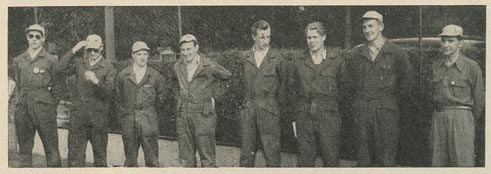
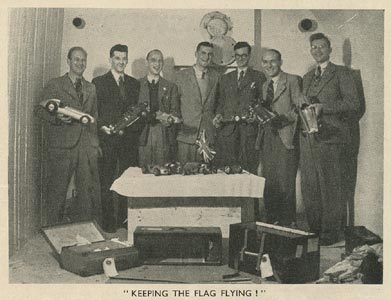
The return leg to Sweden took place the following month with a very different British contingent, only Alec Snelling from the 1st leg making the trip, the rest of the team were from the Derby, Meteor and Nottingham clubs, including Gerry Buck, John Oliver, Harry Howlett, John Walker and 'Ernie' Jackson. The cars were quite different to those raced at Christmas Pie as they were all of much more scale appearance, and all of British origin, including Gerry Buck's 'Topsy' and Harry Howlett's very detailed models. It was also the very first outing for the new, disc valve Oliver twinshaft, the precursor of the all -conquering Tiger motors. British team in Sweden L:R Snelling. Buck. Jackson. Thorpman. Oliver. Walker. Howlett. |
|
The opening event was indoors at 7.00pm with a crowd of around 1,000 despite a clash with the Swedish Speedway Championships. The Swedish only had mite cars so did not compete in 2.5cc won by John Oliver with Busy at 103kph and Gerry Buck 2nd with his little Elfin powered Wee One. 5cc was again down to the British but the Swedish came out top in each of the 10cc classes with Erik Thorpman fastest in two. Gerry Buck did manage 2nd in the Custom class. The results are revealing as the classes were divided into Streamline, Catalogue, presumably for unaltered commercial models and Custom for the home built cars like 'Topsy'.
The final meeting of the trip was at Orebro but again indoors and in the evening, this time with an even larger and more vociferous crowd. Gerry Buck beat John Oliver in the 2.5cc class, but so impressed were the Swedish with the 2.5cc cars and engines that they committed to adopting that as a class. It was reported that JO returned home with orders for 50 Oliver engines. Walker and Snelling again were top in the 5cc class but at very modest speeds whilst the Swedish were way ahead in all the 10cc classes. Gerry Buck managed 3rd place behind Thorpman and Jagne. Jackson did not feature in the results at either meeting, which may have contributed to the acquisition of the two proven 10cc race cars?
|
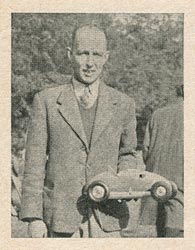
So the exchange trip was over with an interesting comment from Jackson that 'The Swedish hospitality is quite beyond anything we Englishmen give or expect'. We know from later contemporary reports and the events of 2019 that the hospitality extended to Jackson becoming the owner of two Swedish 10cc cars, the 'Railton' with the Dooling motor and what appears to be a home produced car with a McCoy 60, but can they be tied down any further? Well, from earlier reports from Swedish meetings, Harry Blomqvist and Bernt Nilson raced the cars that matched these descriptions, so they could well have been the source, but this is speculation with, as yet, no photographic evidence. What is known from race reports is that Jackson ran these two cars for little more than a season, initially in grade A with speeds up to 115mph qualifying for the MCA National Speed Championships in 1950 before being downgraded to B status as the Dooling Arrows etc moved the 10cc class on significantly. Right: Jackson with the Dooling car |
|
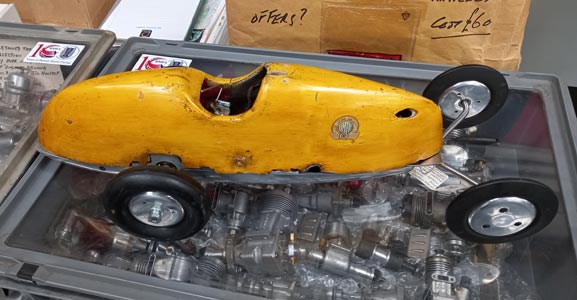
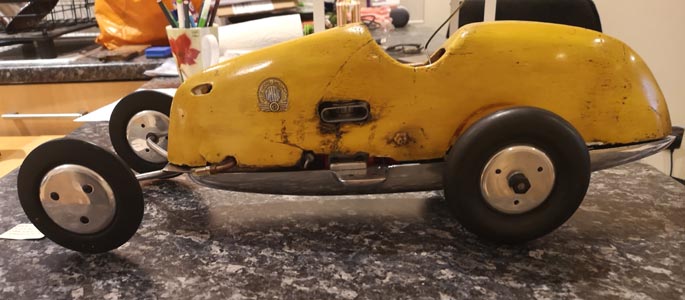
As for the cars, it appears that they both came on to the market in the UK during 2019, certainly one via an auction in Exeter, but no clues now as to the vendor. The Dooling 61 powered one was the first to come to our attention and whilst at first glance the car seems to be a standard McCoy Railton there are one or two oddities. The Dooling is much narrower than a McCoy, yet the motor seems to fit, and the mounting lugs come right to the edge of the pan.
|
|
|
|
Dooling powered car as found in 2019 |
|
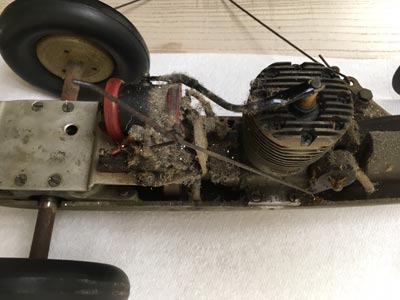
The gearbox again looks standard McCoy presenting the possibility that the pan is actually a copy or a second generation casting? The motor has obviously done duty in a speed plane having the exhaust cut and the fins shaved. It still has the serial number (4612) and the correct Dooling fuel cut off. The front axle is not a McCoy but a sprung steel replacement. The body is hand carved Balsa rather than GRP again suggesting the pan might be smaller than the original? This is the car that Jackson seems to have run in most competitions with wins and places at several venues in 1950 and 51.
 |
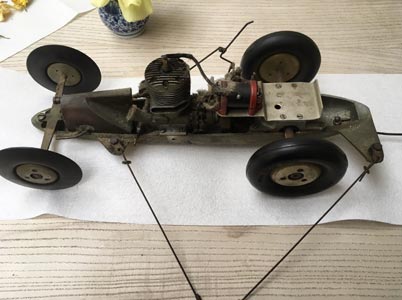 |
| Shaved Dooling 61 on coil ignition | Looks like a 'Railton' pan and gearbox? |
|
|
The McCoy car has had a more chequered recent history having been bought out of the Exeter auction by a well known dealer, sold on and subsequently passed to the owner who showed it to us us at the swapmeet in 2024. When sold in 2019 it was showing all the patina of its seventy years, just as we like to see them. The owner at the time asked our advice as to what he should do to restore it, even suggesting that he would like to make a new body. We tried to persuade him in the strongest possible terms to do as little as possible, other than a light clean. Unfortunately he left before we could take any photos. Left: Six years on and three subsequent owners |
We were contacted in late September 2025 to ask if we could assist someone new coming to Buckminster who wanted to run a vintage spark ignition car. On the day, he duly turned up and to our surprise it was the Jackson McCoy again. Apart from the body (thankfully), everything else had been polished within an inch of its life with all the period fixings being replaced by new items. No way was it in a runnable condition but much to our surprise, he was very keen to sell it, which created a great deal of interest. Ultimately another stall holder dived in and bought it for less than it sold at the auction. This did allow us to look at it more closely, although that was not too much help.
|
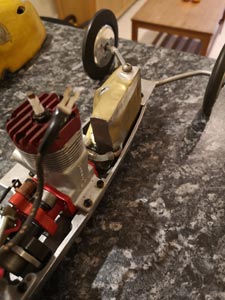
The pan was very typical Swedish with a single bridle bracket, very short with the front wheels extended well in front of the car, again a Swedish trait of the period. The gearbox is McCoy but what else is original now is impossible to tell. An ignition cut off waved about in the breeze and having seen the original auction description it is almost certainty that the McCoy motor is not the one that was in it when Jackson had it as it looks far too new and unrun. The Swedish race reports shows Blomqvist having a 'Zettis car' with a McCoy, so could this be it? |
|
What is odd and as yet unexplainable are the origins of the pan. Obviously far too short for a 10cc car, but with the bridle attachment in the correct place for the car. Was this a later addition to a repurposed pan? Another of life's mysteries.
 |
 |
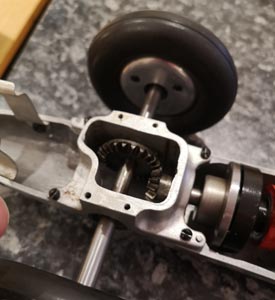 |
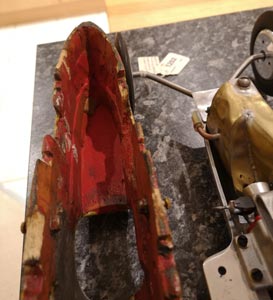
| McCoy looks 'too new' | Balsa body | McCoy style gearbox |
Two lovely cars from the early days of tethered car racing, both in 'as found' condition six years ago. That the McCoy one has had some unwanted attention is unfortunate, but at least the Balsa body with the Derby Club decal has survived unscathed. This confirms that there are still 'gems' out there waiting to be discovered, and long may it continue. Thanks to the current owners of these two cars for the photos and to Miles Patience for searching out details of the 2019 auction and subsequent owners of the McCoy powered car.
©copyrightOTW2026