|
Home Updates Hydros Cars Engines Contacts Links Contact On The Wire Manufacturers History |

|
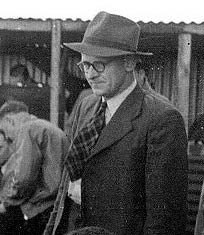
Miniature Race Car Specialists Rowell Motors, based in Dundee in Scotland, who advertised themselves as were one of only two British companies that produced cars and engines specifically for competition. Wilfred G Rowell gave his name to the company that marketed their products through Brian Sherriff's model shop in Victoria Road, Dundee. Wilfred George (Wilf) Rowell was a design engineer, working on industrial cranes. Along with Brian Sherriff and T Scott registered Rowell Motors as a limited company in 1949. Rowell continued working on cranes until his death in 1980. As far as is known, Rowell Motors contracted out the manufacturing of all its products and the model shop was an accommodation address and distribution point. |
|
|
|
Rowell introduced the first of the serious 10cc racing engines in this country in 1948, followed by a range of components, tyres and wheels, and finally a complete car, the Rapier. A mark II version of the engine followed in 1950 along with a more conventional tethered car, the Sabre, that was almost a direct copy of the very successful Dooling Arrow from America. More development followed for the 10cc motor, and a series 2 version was released, which was the last product to be marketed. Like so many other companies involved with tethered car racing, a change in the market, problems with material and labour supply during the years of austerity in Britain and the superiority of the American products were to be the downfall of this company. Left: Victoria Road in Dundee around 1949. Brian Sherriff's shop is on the right hand side of the road towards the end of the photo. The area was demolished in the mid 1960s and much of the remaining Rowell stock was consigned to a skip at this time. |
Rowell Motors continued to sell off stock through the early fifties and items could still be purchased from Sherriff's until the shop was demolished for redevelopment in the mid 60s. The Rowell 60 still holds the record as the fastest commercial British engine to power a tethered car. The engines, cars and accessories that were produced on behalf of Rowell remain rare and desirable items.
Review of Products
|
|
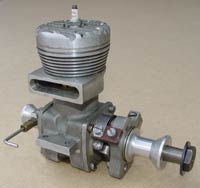
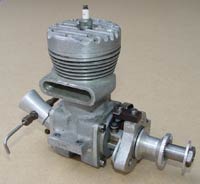
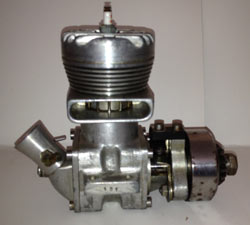
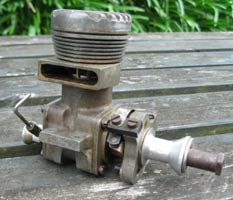
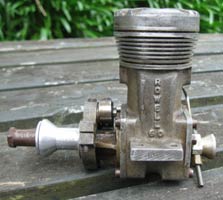
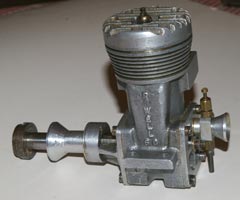
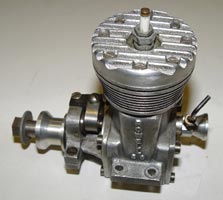
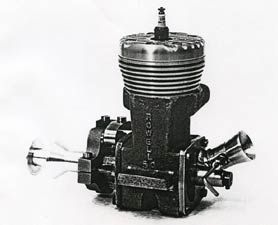
The Mk I Rowell 60, introduced in 1948, is essentially a British version of the American McCoy. Quite crudely cast and relatively heavy, it was available for car or aeroplane use at £12. It was also offered in a glow version for 50p less, but none of these have yet been discovered. It was not on par with the American motors in terms of power, but because of import and currency restrictions, was on general sale, unlike the motors from the States that could only be obtained by clandestine means. |
|
|
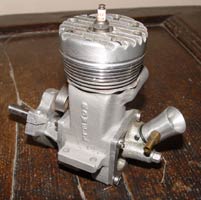
A Mk II version of the motor, was announced in 1950, and was considerably cheaper at £9-17-6. The crankcase was lightened with the rounded cast exhaust stack distinguishing it from the square machined version on the Mk I. The transfer bypass was also enlarged and a new die cast piston fitted. A die cast back plate with a downdraught venturi completed the changes. These alterations still left the motor short on power compared with the Doolings and McCoys. |
|
|
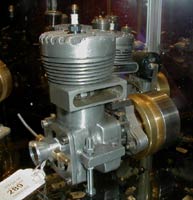
The final motor to be produced was the Mk II series 2. The only distinguishing feature is the venturi that is set at an even steeper angle, requiring a new back plate casting. Rowell's claimed 1 3/4 bhp for this engine? Even at this stage, coil ignition via a standard Lucas contact breaker was the norm, even though glow plugs or magnetos were almost universal for high speed competition. |
|
Rowell Motors supplied a complete range of components for tethered car use including the clutch unit illustrated here, engine mounts, wheels, tyres, coils and accumulators. All of these, like the motors, were manufactured elsewhere and branded as Rowell items. |
|
|
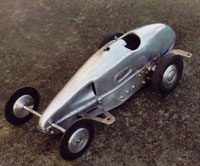
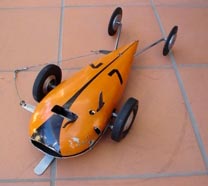
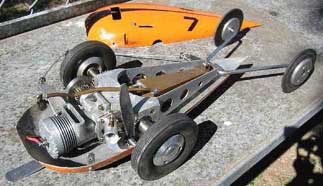
The Rapier car was quite unlike anything offered by any other manufacturer. With the exception of the gearbox and nose castings it was built from stock materials and suitable for home building. The lovely aluminium body shown here was produced for the complete cars. Home constructed cars would have carved balsa, paper or GRP bodies. The complete car would cost £29 (in excess of £1000 today) |
|
|
The Sabre, now with a conventional chassis pan, is a British version of the American Dooling Arrow. Even the wheels and tyres are similar to the products from the States. Rowell's could supply a hand formed aluminium body for this model as well, although none of these seem to have survived. |
In search of Rowell engines and cars
My thanks to all those who have sent details of the serial number and Mk of their Rowell engines in response to my plea. This will be an on going project to enable George Blair and I to gain some idea of how many were produced. If you have, or know of a Rowell, please would you contact me? Email: otwmedia0@gmail.com
|
|
|
Jo Lomax has sent details of her late father's Mk I number 157. It has obviously seen service in a tethered car with its close coupled gear and flywheel, which we would like to discover more about. What makes it even more interesting is the Mk II series 2 backplate and venturi that has been fitted at some stage along with the spare glow front housing. Thanks to Jo for details and photos May 2014 |
|
This early Mk1 appeared on eBay in January 2012. Rowells rarely come onto the market and this one was even more unusual, being in New Zealand. The serial number of 116 places it at the beginning of production. With the exception of the piston rings which are missing the motor is otherwise in original condition. A final sale price of £606 makes it the most expensive MkI yet. It now resides in Canada. Thanks to vendor pietenpol for photos and information |
|
|
 |
 |
 |
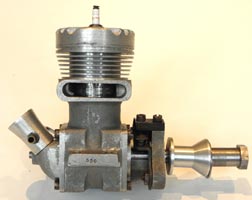
From Steve Betney comes photos of this
immaculate MkII series 2 that was offered on ebay in 2011.
The serial number is
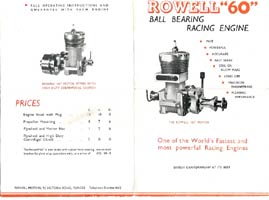
556 and along with it was the brochure illustrated, which is for the MK I motor.
|
|
Bought some years ago
from a club member who found a Rowell something of a handful in an
aeroplane. Apart from the missing timer this early example #124 is in
very good condition having had little use. A new timer is under
construction. Thanks to David Eade for photos and details of another Mk
1 Rowell. |
|
There have possibly been just four complete Rowell motors offered for sale in the last six years. This Mark 1 from Doug Walton's collection was offered at Mellors and Kirk of Nottingham in September 2009 along with a Nordec and a Craftsman Twin, in the same lot. The serial number of 111 makes it early in the production as it seems likely that the numbering started at 100 as was often the custom. |
|
|
From a regular contributor has come details of two motors. This Mk II Series 2 has had to be extensively rebuilt and the engine number disappeared along with the mounting lug. He also has a nice example of a Mk I with the serial no 137 |
|
Thanks to Ken Smith for photo's of this pristine Mk I that appeared at Christie's in 2004. Numbered 106 this represents the earliest engine known so far. Unusually it also has an original Rowell centrifugal clutch fitted for use in a tethered car |
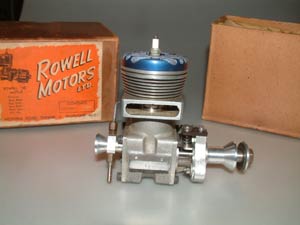
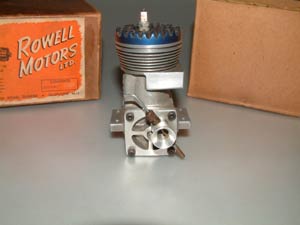
This sparkling example of a Rowell Mk I is the rarest of finds, NIB and never mounted although the treatment of the cylinder head has raised a few questions. Some heads have the fins well rounded off, whilst others have just the very top edges rounded. Is this a factory anomaly and was the anodising original, or added later? The serial number is 152 that makes it one of the later ones discovered so far. Thanks to John Goodall for photos of this motor and the pristine box.
 |
 |
 |
A second Rapier
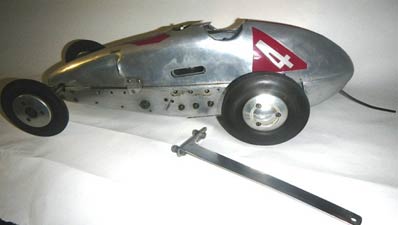
Update August 2020: Since the original article was published thirteen years ago a number of Rowell related items have emerged including the only other factory produced Rapier known to exist, which has the complex, two part, formed aluminium body. The only other original Rowell Rapier known to exist until now is currently owned by acknowledged Rowell enthusiast George Blair, who contributed so much to the Rowell articles published previously. The publication of these articles brought further information about this car from Sam Alexander who had obtained it in the 1980s from the daughter of the original owner, R G Cameron of Gatehouse in Fleet, Kirkcudbrightshire. Now Mark Osborne has kindly sent us photos of a second Rapier from the collection of the late Peter Larsen.
 |
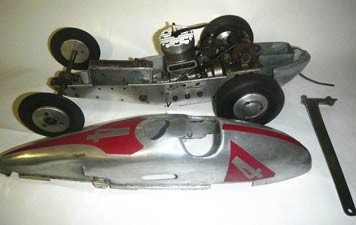 |
The discovery of this car seems to confirm that the complex aluminium body was produced commercially for the Rapier, as it is identical to the one on the Cameron car. Although a panhandle has been fitted at some stage, the original holes for the tether brackets can clearly be seen.
 |
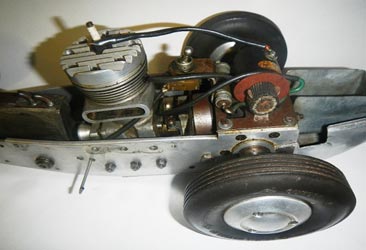 |
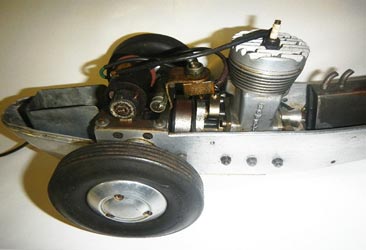
The motor in this car is also interesting as it is clearly a MK II, but with the older MK I backplate. There was a school of thought that reckoned this was a better combination than using the newer version with the downdraught venturi. Mark did not feel it appropriate to disturb the engine so the serial number is currently unknown.
We are most grateful to Mark Osborne for passing on details of this piece of English tethered car history, but we can’t help wondering how it came to be in Australia?
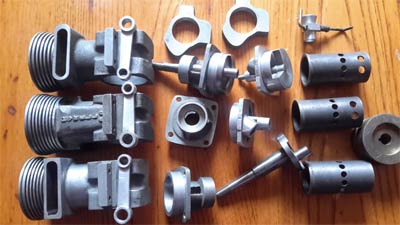
This amazing selection of original Rowell parts was discovered at an auto jumble by Ian Douglas who had flown a speed model fitted with a Rowell many years ago. Eric Offen has kindly completed the assembly of the engines that are just awaiting head castings for two of them.
 |
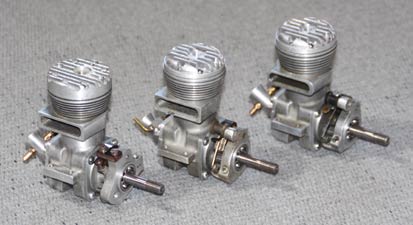 |
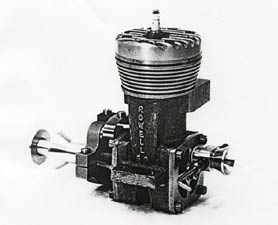
These Original Rowell photos of the three marks of motors appeared on ebay in 2019. in order, Mk I, Mk II Series 1 and Mk II Series 2
 |
 |
 |
From Victoria in Australia, Warren Evans has sent the following:-
I own a Rowell Teardrop. I believe it to be the 'Only One in Existence' to my knowledge.
|
|
|
I purchased the Rowell Teardrop in Tasmania on condition that it was not to be sold overseas EVER. It has only been run twice to my knowledge. Once in Hobart in 1950, officially clocked at 107.5 MPH which is within a bees of 173 KPH .It was then left dormant until I brought it in 2004. I took it to Sydney in November of that year to run in the Oldtime Meet they have there each year. However we had troubles with it, when the tank was pressure tested it must have stirred up some scale which had formed over the years between 1950 and 2004 (54 Years in total). We have however copied the tank. But it has not been run since as we don't have a track in Melbourne.
The serial number of the glow plug engine is 608 (Mk2 Series 1) which is as I received it. However it could have been altered as I brought through a friend in Hobart. The owner ran a Hobby Shop, but because of poor health was retiring. He could have sold it for a large amount of money but did not want it to leave the country. Besides some people think they can buy anything by pure weight of chequebook( It ain't necessarily so).
The body is hand beaten and car was built from information supplied with the
engine. Wheels and tyres are in excellent condition and are Rowell's. Gears are
spur and interestingly from the firm I buy gears from for my other tether cars,
(of which I have 12 & more on the way) and is owned by a chap
by
the name of Rowell who tells me he is a relative of Wilfred's.
Any one who has taken a Rowell Engine apart will tell you it is far superior
to both the Dooling and the McCoy. If fully developed and run against either of
the previously mentioned engines. History would have been written differently on
which was the more SUPERIOR????
I wrote an article in the "Australian Model Engineering" magazine under the title "So Rare" Issue 116 in 2004. I'm not interested in modern speed cars as I'm an 'Old Hot Rodder' who likes old stuff and builds copies of early cars but doesn't mind using later motors to help them on their way.
©copyrightindividualcontributor