|
Home Updates Hydros Cars Engines Contacts Links Contact On The Wire |
Hell’s Bells
A boat, not an
exclamation!
|
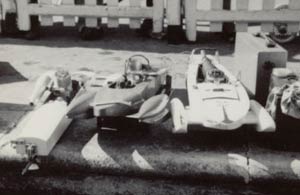
Stan Clifford of the Victoria Club became involved with tethered hydroplanes in 1923 and was still experimenting with hulls and engines well into the 1970s. He was responsible for possibly one of the shapeliest boats ever, the ‘A’ Class ‘Poly Ester’, built as the name suggests from GRP and when the motor cooperated, very fast. Having heavily modified the motor from the early 50s
onward, Stan started experimenting with a motor based on Suzuki
components. Having moved to the St Albans Club, in 1966 he turned up
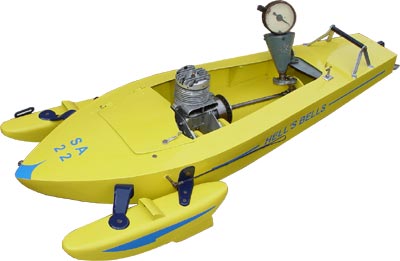
with an entirely new hull named ‘Hell’s Bells’. This was similar in
design to 'Poly Ester' but from wood with a much larger centre section.
|
|
After several years of experimentation with the Suzuki motor that was abandoned, and the original motor, by now minus its mounting lugs, was installed. Stan was lucky in having access to a farm pond near to his home and continued to experiment and alter the boat and engine. The last alteration was a pair of outrigger sponsons with air scoops on the top that vented on the running surface between a pair of fences.
The is no contemporary evidence of the boat running in this state and following the deterioration of Stan’s health it was passed on. At some stage the motor suffered a comprehensive blow up, which may well have inspired the then owner to refurbish the boat, but as so often is the case, this never happened. Norman Lara obtained the remains and kept them for a while before indicating that he was prepared to part with it, which is when I became involved. An original boat and engine in any condition is a magnet for me, and so after some negotiation a virtual kit of parts came home.
|
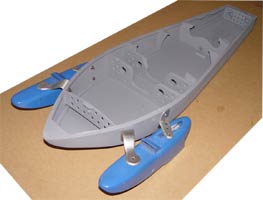
Oh dear. The hull had been more or less stripped out and Nitromors had made serious inroads into the original yellow finish. Sponson brackets had been drilled out to remove the screws, leaving large holes in the aluminium. The motor had a broken crankshaft, no piston, and a hole where the combustion chamber used to be. In case it is thought that the news was all bad, everything that had been taken off, or out of the hull had been saved, so in a way it was ‘all there’, if in a bit of a state. |
|
|
|
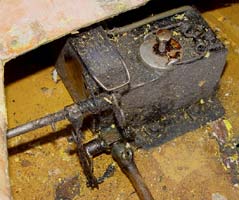
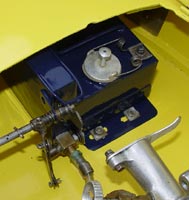
This was another case where there was no dilemma about the degree of restoration required, as the previous action now dictated a complete refurbishment from scratch. The first difficulty was getting the fuel tank and very complex fuel ‘knock off’ out of the hull. A series of links, pins, screws and nuts, were all set solid with 40-year-old castor oil. Brute force was not an option, so thinners and gentle persuasion got me there in the end. Getting the congealed fuel out of the tank and fuel cock required a very long soak in thinners, with what came out looking very unappetising. |
|
The major problem was how to get rid of all the old paint from the inside of a wooden hull, and here I have a fairly radical procedure. Pick all the paint out of the screw holes, take out the screws and gently remove the deck. So much easier to strip paint from an open hull. Only problem was that no stripper would touch the primer that Stan had used. Eventually it had to be dissolved and washed out with thinners. What a messy job that was. |
|
|
|
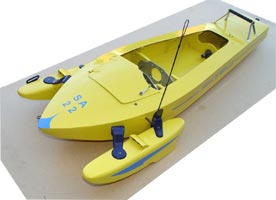
Getting down to the bare wood revealed some bad news with obvious signs of a bonfire, damaged wood and dozens of redundant holes. Oddly, I now had to reassemble the entire boat to see what holes were current and what needed filling. With all the repairs completed, the inside of the hull was primed and sprayed yellow to match the original colour. Yellow and a pale blue were the colours of the St Albans Club that Stan joined later in his career. The deck was treated in the same way and then glued and screwed back on. Painting the outer surfaces is something of a doddle compared with the insides, and soon there was something resembling a complete hull ready for all the additional parts. |
All brackets had been cleaned and sprayed to match the colour they had been, and were put back on with some very unusual flat-headed brass screws that cleaned up pretty well. Mind you, I am not sure about the bridle attachments as these are just two screw eyes screwed into the side of the hull. Now illegal and I am not sure I would have trusted them anyway with this weight of boat running at 70+mph. Pictures were available to scale the name and trim from, and luckily, before stripping the paint, someone had measured the sponson flashes. Humberston Signs cut all the trim and names from vinyl and they offer a superb service for this type of venture.
|
|
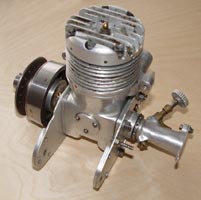
The hull was now finished down to an original prop that was still on the shaft, but no engine. Here I was seriously stuck, as the main bearing could not be replicated, despite many enquiries and adverts, which brought everything to a standstill. Last October, a knight in shining white workshop coat emerged. Ron Hankins offered to sort out the problem of the bearing and then make a new crankshaft to suit. Having made a new shaft he then thought that a piston was required, with some rings for compression, and of course a combustion chamber insert to suit. |
|
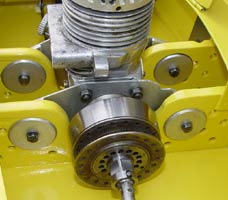
The motor has a most unusual clutch on the flywheel, which he got working, and then fitted to the new crank, finishing the whole thing off with a coupling to match up with the original cardan shaft. I picked up the complete motor at the beginning of February and Ron had made a superb job of resurrecting it from the box of bits I had passed to him. Without Ron I am not sure the project would have ever been completed, so my grateful thanks to him for his efforts and interest. |
|
|
|
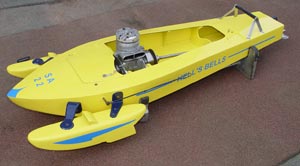
With the motor to hand, it was the work of minutes to bolt the mounting plates on and get it back into the hull. Everything fitted perfectly, which was something of a relief after all the work. The only element that is missing is an exhaust system. What was used in the boat’s last incarnation was not an option as this had not worked and was what had set fire to the boat. No pictures exist with this earlier motor in, so nothing to go on at present, which will require a little more thought and research before metal is cut. |
A final bit of luck was the rev counter that Stan had built was included with the parts and in the bag of odd bits that Norman retrieved from his workshop, was the worm drive system for this. It did take a few minutes to sort out how all this fitted, but eventually it all slotted into place to make ‘Hell’s Bells’ complete and a fitting tribute to Stan Clifford and his willingness to experiment, right through to the end of his racing days.
 |
 |
 |
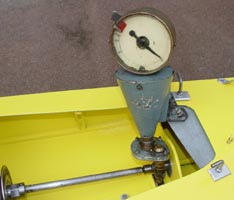 |
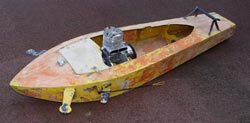
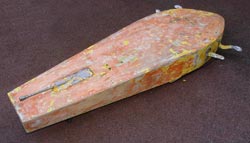
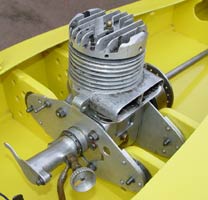
| Reed-valve 30cc motor | Flywheel and clutch | Tank and knockoff valve | Cardan shaft and 'rev' counter |
Thanks go especially to Norman Lara for keeping all the bits of this boat together and enabling the restoration to happen and to Ron Hankins for creating a very workable motor from the mess I gave him. Thanks also to Jim Free for heading photo, Steve at Humberston Signs for the graphics and Graham Smith for the discount on all the paint I used.
©copyrightOTW2010
‘Cutie?’ A restoration project that became something more.
|
Several years ago I was shown the hull of what looked like an early tethered hydroplane. It was single stepped, boat shaped and very deep. What was unusual was a keel piece running from the bow to the step. It had been painted all over with coat of green paint, which covered any evidence of its origins. A model aeroplane enthusiast had discovered it in a shop in Norfolk, but was more interested in the 10cc Brown Junior lurking inside. |
|
A deal was done for the engine, and there it was left until the aeromodeller happened to tell a friend of his where the motor had come from. He was promptly despatched back to Norfolk to buy the hull as well, which then was consigned to a garage for many years. I hate to see boats being neglected, and after several attempts, an agreeable swap was arranged.
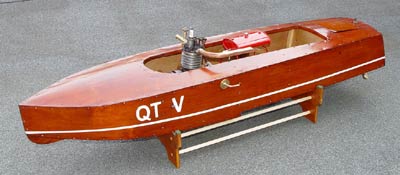
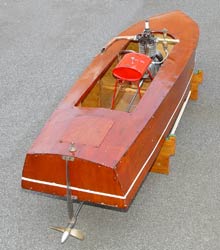
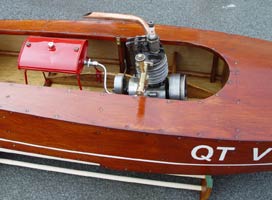
Having brought the hull home it was possible to have a good look at it. The Brown Junior was obviously an afterthought as there was a substantial pair of brass engine mounts to fill the space once occupied by a much bigger motor. There were tether points on both sides of the hull, split pins through the sides and through reinforcing strips. This system had been seen before, usually on deeper hulls. The skeg was there and indicated a straight shaft and a talcum powder tin on the foredeck had done duty as a fuel tank. The best bit though, was that holding the hull to an oblique light revealed the shape of a name or registration number underneath the green paint, ‘QT V’.
At this stage, I was unable to identify the boat, who had built it, or even an approximate age, although the shape looked from the late 1920s or early 30s. What was obvious was that it had been built with steel screws and every single one of them had almost rusted away. These had to come out before anything more could be done and luckily they had rusted so badly that there was little grip on the stringers, so with a bit of care, and several days work, all but three came out. Something I have learned is that very early boats used just shellac as glue, and until resin and aircraft glues came onto the market, what was used was glue in name only and probably did no more than fill the joints. This boat was no exception and soon I had a complete kit of parts, with no two pieces of wood joined. A novel place to start, but it made cleaning off the grotty paint a doddle. With the boat in bits, it became obvious that is had been very well made, but I was still no nearer with an identification.
|
Rebuilding the hull was relatively simple, but this time I used Cascamite and brass screws, seemingly boxes of them. I did have to scarf two small pieces of ply in where the rot had done its worst, but otherwise it was in very good condition for a hull of that age. Unusually for me, a motor was no problem as I had an equally unidentified four stroke of roughly similar vintage that looked as if it would be about right. Fitting out was just a matter of making a new shaft and couplings, with a neat, but dummy outlet, to disguise the rough hole cut in the side of the hull for the Brown Junior exhaust. Peter Hill's wondrous spares box provided a period prop to complete the drive train. With several coats of shellac reddened to match the original and a hand painted name, the job was more or less done. |
|
It still niggled me though, that even with the name it had not been possible to identify the boat. Peter Hill said that he had recollections of seeing details of it somewhere, and suggested that it might have been a design by J.C Hudson. After looking through twenty years of Model Engineers and other magazines I was no nearer finding the answer, even after it was featured as a 'pitbox' item in Sept 08. Peter then had another moment of clarity and thought that he had seen the design featured sometime in the 1920s. This was quite exciting, but again going back even further in the MEs still did not reveal anything. I was now at a loss until Peter again came up trumps. Looking through the early magazines for something else he had come across ‘A design for a Metre Hydroplane Hull’ in the Dec 17th issue of ME for 1931, and there was the 5th in the QT series, by D.C. Jeffrey. That begs the question as to why I did not suss it out earlier? Well, sod’s law, being what it is, dictated that of 40 years of Model Engineers, which issue was missing? Yes, Dec 17th 1931, yet another bizarre coincidence.
|
D.C. Jeffrey was very active in Scotland around that period, and published several articles in ME. He claimed that ‘QT V’ had a ‘good proved performance’, ‘planes level and steady with practically no wash’, ‘is easy and inexpensive to build, yet has a fairly good appearance’. The earlier version of the design, QT IV is illustrated, fitted with a flash steam unit. To accommodate this power unit, the depth of the hull was increased to 5 inches, which Jeffrey’s admits made it look too ‘dumpy’. He does give alternative construction for QT V to allow a flash steam unit to be fitted. |
|
Unusually he provides a material list:-
One sheet, 4ft by 3ft 6ins 1mm three-ply 3/6 (17½p)
Eight strips 5/16th sq by 4 ft long white pine 1/- (5p)
3 gross iron woodscrews 3/8 long by 2g 1/9 (9p) (I knew there were a lot!)
One tube liquid glue 0/9 (4p) Total 7/- (35p)
|
Boat building was cheap in those days! There are no details whatsoever about motors, engine mounts, fuel or ignition systems, running gear or anything else, which was all left to the constructor. Now I know the identity and true age of the boat, I think I will look for a more appropriate motor, such as an Atom 3, to finish the whole thing off. Well, thanks to Peter Hill, I know I have a Jeffrey’s QT V, but whether it is his QT V is quite another, and intriguing, question. It does make for a very satisfactory conclusion to a restoration though. |
|
©copyrightOTW2009