|
Home Updates Hydros Cars Engines Contacts Links Contact On The Wire |
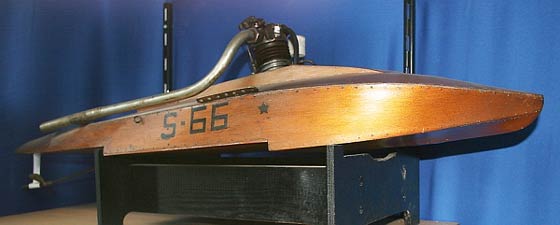
Chrysis, a survivor from the 20's and Little Star

|
|
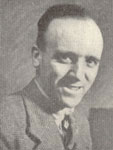
Lionel John French featured as the eighteenth Who’s Who in Model Engineering in May 1937. He started life as a dentist, moved into engineering and became involved in patent and experimental work, eventually designing and building automated book binding machines. His involvement with tethered hydroplanes started in the early 1920s as a teenager, competing with a flash steamer and continued with a series of boats, amongst them Chrysis, Angel and Cigarette. |
|
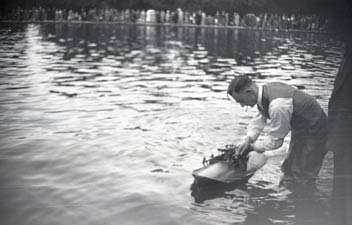
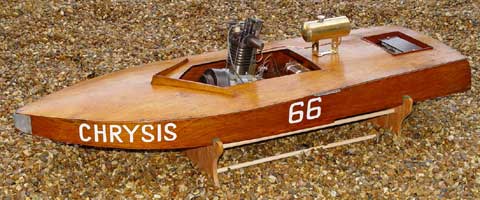
He was largely responsible for reorganising the South London Power Boat Club in 1926 and running it until 1930. During the 1930s French contributed numerous articles and design features to the Model Engineer, both under his own name and the pen name 'Spectator'. His best-known boat was the record breaking ‘Little Star’. In May 2006 'Pitbox' revealed details of a very early boat that had been discovered. The true significance of this 'find' was appreciated when carrying out research for the centenary. The only other surviving hydroplanes that are known to predate it are flash steam powered, which makes 'Chrysis' one of the oldest known IC engined hydro's. Boats that have survived from the 1920s are exceedingly rare and here is the full story of one that has, along with its subsequent restoration. Right: French and Angel |
|
|
|
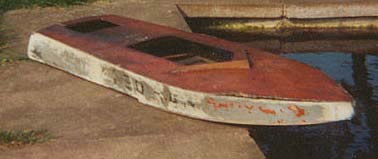
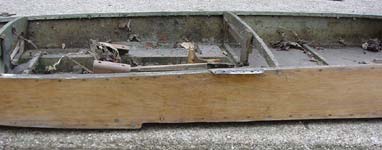
In the mid 1980s the dilapidated hull of an old tethered hydroplane was discovered in a shed in Glenridding on the shores of Ullswater. It was originally thought to be similar to Westbury’s Golly design, but as that was a scow and the boat discovered was boat shaped then that could be discounted. The only clue was a name on the sides, Chrysis. At that stage the then owner contacted Peter Hill, the MPBA historian who was able to identify the boat from the name and ascertain that L.J.R. French of the South London Club had built it in the late 20s. As the boat predated Mr French’s record breaking Little Star by some six years it was considered to be a significant find and passed to Peter. |
The boat had numerous coats of paint of obscure origin and he started strip down the outside of the hull. Having worked through white enamel the original name could be clearly seen incised into the plywood. The boat had been altered numerous times and there was considerable damage to the deck and internal woodwork, and the remains of a very crude fuel tank support were evident. All the running gear was missing, as was the engine. All in all a sorry state, but a very early example of a tethered hydroplane.
|
|
Luckily (Lionel John) French was still alive and he and Peter had a most interesting correspondence about the boat. He confirmed that it was Chrysis and related its early history including the fascinating story of how the engine came to be built. Freddie Ford, who was a friend of his, had built a 50cc opposed twin four stroke from castings he had made at his workplace, Messrs Suggs. French suggested that the crank was so light that the engine would only last seconds, and anyway 30cc was the class limit. This news decided Ford to give up boats altogether, but as the cylinder heads on the engine were very nicely cast with a 90 degree valve angle French said he would use the heads and build two 30cc engines if Ford would get the crankcases cast up. John French built two engines, one of which he gave to Ford, as well as another Chrysis type hull called Comedienne to get him on the water. He also recalled that he had originally finished the boat in shellac with the name in white so that subsequent owners must have added all the other paint. |
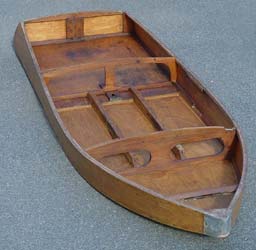
In the early 20s, French was building boats from tinplate as was the fashion, but an inability to form the vee bottom to the hull made him change to ply and Chrysis was one of the first to be built from wood. There is a bit of a mystery here as Mr French talks about Vee bottoms on his boats and in an article in Model Engineer shows the underside of a boat purporting to be Chrysis with the vee clearly visible. Close examination shows this boat not to be Chrysis at all and the actual picture above it shows Chrysis with a flat, single stepped bottom. Chrysis was to be the subject of a series of articles in Model Engineer in 1932, describing how to build a ‘beginners boat’. If it did have a vee bottom at some stage there is no evidence in the construction of the boat.
|
What was clear was that the step had been very crudely moved forward and the engine mounts cut to suit. Other projects and the lack of a suitable engine consigned Chrysis to the shelf for around 20 years until Peter offered it to another member of the Retro Club for restoration. Luckily, with the articles in Model Engineer and John French’s letters there was sufficient information to make the project viable. |
|
|
|
After a lengthy look at the problem it seemed that with the exception of the deck, all the original material in the boat was in excellent condition for its age, and it was only the later additions that had to go. A decision was made to put the step back in the original position and let wood into the bearers, stringers and hull sides to repair the damage. Several weeks were spent removing the shellac from the inside of the hull and the bullet-proof aluminium and fluorescent red paint from the outside until all that was left was the outer hull and the rear half of the bottom. The original step was glued back in and a new front half screwed on and it started to look more hopeful. All the internal frames were rebuilt and put back in and the original engine bearers renovated and refitted. The correspondence detailed the finish that French had used, and so the new wood was stained down to match the old. |
|
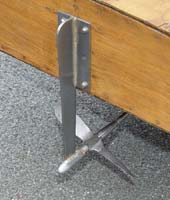
The ME articles included drawings of the skeg so a new one of these was built and fitted. As was common at the time, the prop shaft was straight, with the prop mounted in front of the skeg. Peter Hill was able to provide a period prop, no easy feat as it needed to be right-hand rotation and these are particularly rare. A decision was needed about the deck as it had been liberally drilled for various fittings during its life. A hole had been cut for a battery compartment and part of it had been chewed away somehow. After a bit of thought and cleaning up it was decided to keep the boat as original as possible and use the old deck. To repair the damage new ply was stripped down to individual laminations and then added layer by layer to with overlapping scarfe joints. When stained down the join is barely visible (luckily). The hole for the battery was retained with a frame added to neaten it up somewhat. French finished the boat with shellac, which he brushed on rather than using a ‘rubber’ and so some eight coats of Rustins finest were applied and rubbed down to take the gloss off. |
|
|
|
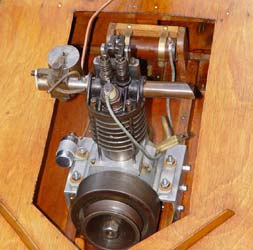
Now came the major problem, engine and electrics. An original coil was obtained at the ME exhibition, which just left an engine. Oh dear, where does one find a late 1920s home built 30cc four stroke. As it transpired, at Gildings auction. Amongst the lots was a 1930 25cc OHV four stroke, built by F.N. Sharp, who was a fellow Club member of French’s. Sharp built his own engines from the turn of the century and went on to design the Grayson as well as building numerous very successful engines for other members of the South London Club. This engine was obviously the basis of the Grayson and its clones, with parallel valves and the inlet/exhaust across the boat. It is identical to the engine he used in his own ME Competition winning Mona, even to the angled stub exhaust. Given that Mona and the engine were stolen it could even be that motor. Not in the same style or league as French's original, but with the likelihood of finding the correct style of motor non-existent, it would do perfectly. The engine lined up exactly and with a coil mount and fuel tank added, the job was almost finished. |
|
Sign writing is not my strong point so repainting the name and racing number on both sides involved a seriously small paintbrush and a magnifying glass. It does look a bit crooked in places, but it follows the lines cut in the ply. Chrysis is now 80 years old, and in remarkable condition for its age. Thanks go to Peter Hill for all his advice and assistance during this restoration. ©copyrightOTW2008 |
|
Little Star
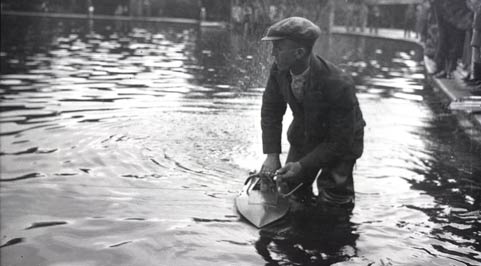
Mr French with Little Star at Brockwell Park
In another of his occasional articles, R.T. Pole discussed what must surely be the prettiest tethered hydro ever built, Mr L.J French’s ‘Little Star’, which was the 15cc record holder from 1936-38.
A ‘polysphenic ship’ was the term used by the Rev. C.M. Ramus in 1870 to describe his 29½" long rocket powered model hydroplane which featured two steps and three equispaced planning surfaces, the literal meaning of polysphenic being many wedges. Over the years since 1870 the multi-stepped hull has been tried many times and the most successful of these was built in 1935 by Lionel French, who had stated in a 1930 Model Engineer, that a multi-step hull could never be as conducive to flat-out speed as a single step hull.
|
|
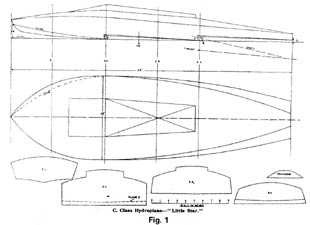
The illustration shows the hull lines of
Little Star, which at one time were available from Model Engineer
for the princely sum of one shilling and eight pence (8p) post free. To achieve the concave vee at the front plane two layers of .75mm 3 ply were laid at 90 degrees to each other in narrow strips, butt jointed and well glued with ‘Le pages’. All stringers were ¼" square satin walnut and the sections S2 and S3 were thickened out to take the deep angle aluminium bearers. |
Although the thrust line on the plan indicates an articulated driveline, the original had a straight shaft, but was changed, as it proved unsuccessful. The propeller was placed in front of the tail skeg and measured 2 5/8" diameter x only 3 ½" pitch, which was much lower than the norm and allowed the engine to run up to 15,000 rpm.
|
|
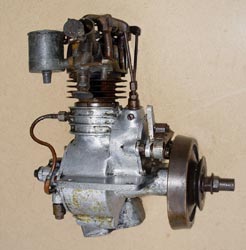
The engine was a single cylinder 4-stroke of 1in. bore x 1 1/8in. stroke giving a capacity of 15cc, and was unusual in having forced lubrication and oil cooling built in. The cast iron cylinder barrel screwed into the oil sleeve of the crankcase, being secured by a locking ring, which allowed variation of the compression ratio, normally set to 8:1. The bronze cylinder head in turn screwed onto the cylinder, being drawn up to final tightness with a draw screw. A high set camshaft operated through parallel pushrods, narrow angle inclined valves of 15/32in. dia. and fitted with hairpin springs. The piston, which had .002in clearance at the top of its stroke, was attached to an H section Duralumin con-rod with a ball raced big end. The overhung crankshaft was supported by a single ball race at the web end and a phosphor bronze bearing at the other. |
|
The crankcase and timing gear case being all cast from aluminium with two substantial mounting lugs either side inline with the crankshaft. A low-level brass fuel tank, filled with a 50-50 petrol-benzole mix was pressure fed to the carburettor, which had a single submerged jet with slot and well compensation. The finished all up weight of the boat was 6lb 14oz not including fuel. On its first outing in late December 1935 a speed of 24.74 mph was recorded, which equalled the then current class record set by Captain C.E. Bowden’s Jildi Junior. Unfortunately the distance covered in the run was slightly less than the 300 yards specified for the ME Speedboat Competition and record ratification and was therefore disallowed. |
|
|
|
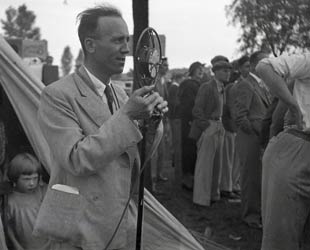
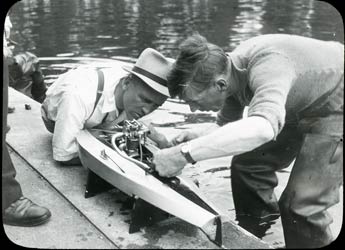
However, early the following year (1936) a speed of 34.86 mph was recorded over the 300 yard distance. This record also gained Mr French the ‘C’ class award in that year’s ME Speedboat Competition. As the current 'B' Class record holder, the boat appeared on the MPBA stand at the Model Engineer Exhibition that year. Over the next three years 'Little Star' was run at most of the London area regattas but never again achieved its record speeds. Postscript. ‘Little Star’ did not appear at all after the Second War and was effectively ’lost’ until 1987 when Peter Hill managed to contact Mr French in the course of research on another of French's boat, 'Chrysis' that had recently been found. He discovered that ‘Little Star’ was still nearly all in one piece and still owned by Mr French. Left: Mr French (in the hat) with Mr Ripper and his Little Star copy Happy Days |
It transpired that Mr French’s interests had changed after the Second World War and the boat had not been run at regattas since 1940. The engine had been bench run, ‘off load’, on several occasions, and on one of these tests 27,000rpm was claimed.
Mr French’s new interest was motor cycle racing and he competed in the I.O.M TT races on five occasions. He raced in the Clubmans classes in 1948/49/51 and the TT itself in 1952 on an E.M.C Puch, finishing 11th, and in 1953 on a Sulby-EMC he had built himself, retiring from the race. A racing crash put an end to his riding career but he continued his involvement, by sponsoring other people.
|
|
L.J. French lightly restored the boat he had built 52 years previously and in 1988 passed it to Mr Hill for safe keeping. ‘Little Star’ was then put on display at the Power Boat Museum at Pitsea where it remained until the redevelopment and eventual closure.
|
OTW thanks R.T. Pole for permission to use the article, Peter Hill of the Retro Racing Club for the additional information and photograph above, which was taken by Mr French in 1987, prior to the boat being restored. Photos courtesy of the Westbury family archive and Ken Smith.
©copyright2006